

Reading through the five-star Amazon reviews for Deep Marketing, I kept returning to one observation from Rukhsana Aziz:
“You don’t get paid for the sacrifice. You get paid for the evidence it leaves behind.”
She was reflecting on the book’s discussion of preeminence and what it takes for a customer to believe that you have their interests at heart.
Her review brought the idea into a very familiar business situation: you quote your price, the prospect pauses, and you immediately begin offering a discount. They haven’t even objected yet. You are already negotiating against yourself.
That is the kind of feedback I find especially valuable as an author. A reader takes an idea from the page and recognises a moment in their own working life.
Several reviews described moments like this. I wanted to share some of them because they reveal what readers are actually taking away from the book, and what they are beginning to reconsider in their businesses.
Rukhsana’s review stayed with me because she connected pricing to the evidence behind a promise. Anyone can describe themselves as trustworthy or customer-focused. The harder question is what a customer has seen you do that gives those words substance.
Have you recommended a less expensive option when it was the better fit? Have you told someone they weren’t ready for your service? Have you admitted a limitation before accepting their payment?
Those are examples of decisions that can give a customer something concrete to judge. They also help explain why trust takes time. A claim can be written in a minute. Evidence accumulates through decisions.
Rukhsana connected this to the confidence with which we state our price. I appreciated that she carried the discussion beyond a pricing technique and into the relationship that exists before the price is mentioned.
Swapna picked up a related distinction. In her review of the pages she had read so far, she noticed that being visible everywhere does not automatically make people believe in you. She also connected the discussion of discounting to the kind of clients a professional attracts.
That distinction matters when you are deciding where to put your energy. More visibility creates more opportunities to be evaluated. What people discover when they evaluate you deserves just as much attention.
This leads to another pattern in the reviews: readers are using CATT to examine the order in which their marketing happens.
CATT stands for Content, Attention, Trust and Transaction. Fouzia captured something useful about that sequence:
“Content → Attention → Trust → Transaction sounds simple, but once you start looking at your own business through this framework, you realize how many things you may be doing in the wrong order.”
You might have an offer ready and an audience that has only just discovered you. You might be publishing useful content without a reliable way to get it in front of the people who need it. Each situation calls for a different next step.
Jackson Monichan Pathilchirayil took this further. He described the framework as a way to identify where a business is breaking down. Content might be failing to attract attention. Attention might be failing to create trust. Customers might be buying without receiving an experience that makes them want to recommend you.
I particularly liked that reading of the framework. It gives you a way to locate the problem before deciding what to change.
If you recognise that people are interested but uncertain, another batch of promotional posts may leave the uncertainty untouched. You need to understand what they still need to know or experience before they feel comfortable choosing you.
Several readers also noticed how far the book follows the customer beyond that decision.
Shubham Chandra specifically highlighted onboarding and service, observing that these are often overlooked in discussions about marketing. Rishabh Jain made a similar point about including the part of the journey after someone becomes a client.
Sankalan Bhattacharya singled out this line from the book:
“How you treat your client after they pay decides everything”.
Payment changes the relationship. The customer has placed confidence in you, and now they get to experience whether that confidence was justified.
Onboarding is their first experience of how you work. Service shows whether you can deliver consistently. Transformation is the meaningful change they came to you for. Together, these experiences shape what they will eventually say about you.
Maxim’s review connected these stages, Onboarding, Service and Transformation, to reputation, referrals and the possibility of longer relationships.
As an author, I am glad this part is registering. The promise that attracts a customer and the experience that follows belong in the same conversation. A business has to take responsibility for both.
Another review described a problem that many skilled professionals will recognise.
Writing under the name Starstuff, a reader explained that they had left a software engineering job assuming their technical ability would be enough to build a business. Their lack of marketing knowledge became a significant obstacle, and they spent considerable time learning through trial and error.
Their story captures the gap between being able to do valuable work and helping a prospective customer understand its value.
Jackson touched on the same difficulty from the customer’s perspective. People often cannot judge your expertise before buying. If every provider looks and sounds similar, price becomes one of the easiest things to compare.
For a consultant, freelancer or other professional, this makes communication part of the work of building a business. You have to help people understand your thinking, your approach and the problem you are equipped to solve.
Yash Shah expressed the aspiration behind this beautifully. His review spoke to people who would prefer to keep “honing and mastering your craft” while finding customers who value that work.
That is an audience I care about deeply. There are capable people who want to spend their working lives doing something useful, and who need a way to make that usefulness visible and understandable.
For some readers, personality is part of that challenge.
TSK described the book as marketing for people who are not loud and do not feel at home in the online marketing world. Lalitha explicitly mentioned being an introvert. She appreciated the accessible language and illustrations, and said she planned to apply the ideas particularly to pricing and positioning.
I found those responses meaningful because marketing can feel like a demand to become a different person. If the examples you see reward constant performance, you may assume there is little room for your own temperament.
Teaching through an article, explaining a problem carefully, or answering a question with patience can also give people a reason to pay attention. These are forms of communication that a thoughtful professional can practise and improve.
Aniket Borhade connected this approach to his experience of my digital marketing internship and the 100-day blogging challenge. He recognised the emphasis on creating useful content and building trust over time. He also disclosed that he had received a complimentary copy of the book.
His review was a reminder that some readers are encountering these ideas for the first time, while others are recognising principles they have already worked with.
The reviews about implementation were especially encouraging.
Suryadeep described the experience of moving through the chapters as progressing through a video game. A chapter opens a conversation, the illustrations help him reflect, and the summary and action steps give him something specific to do before continuing.
What stood out was his description of feeling clearer about how to begin. He connected that clarity to feeling less held back by imposter syndrome and perfectionism. Having finished the book, he planned to return to it as a manual for implementation.
Pawan also singled out the recurring “Three Things to Remember” and “What Next?” sections for turning ideas into action points.
These details tell me something useful about the reading experience. When the next step is clear enough, a large subject becomes easier to approach. A reader can work on one decision, see what happens, and return with a more specific question.
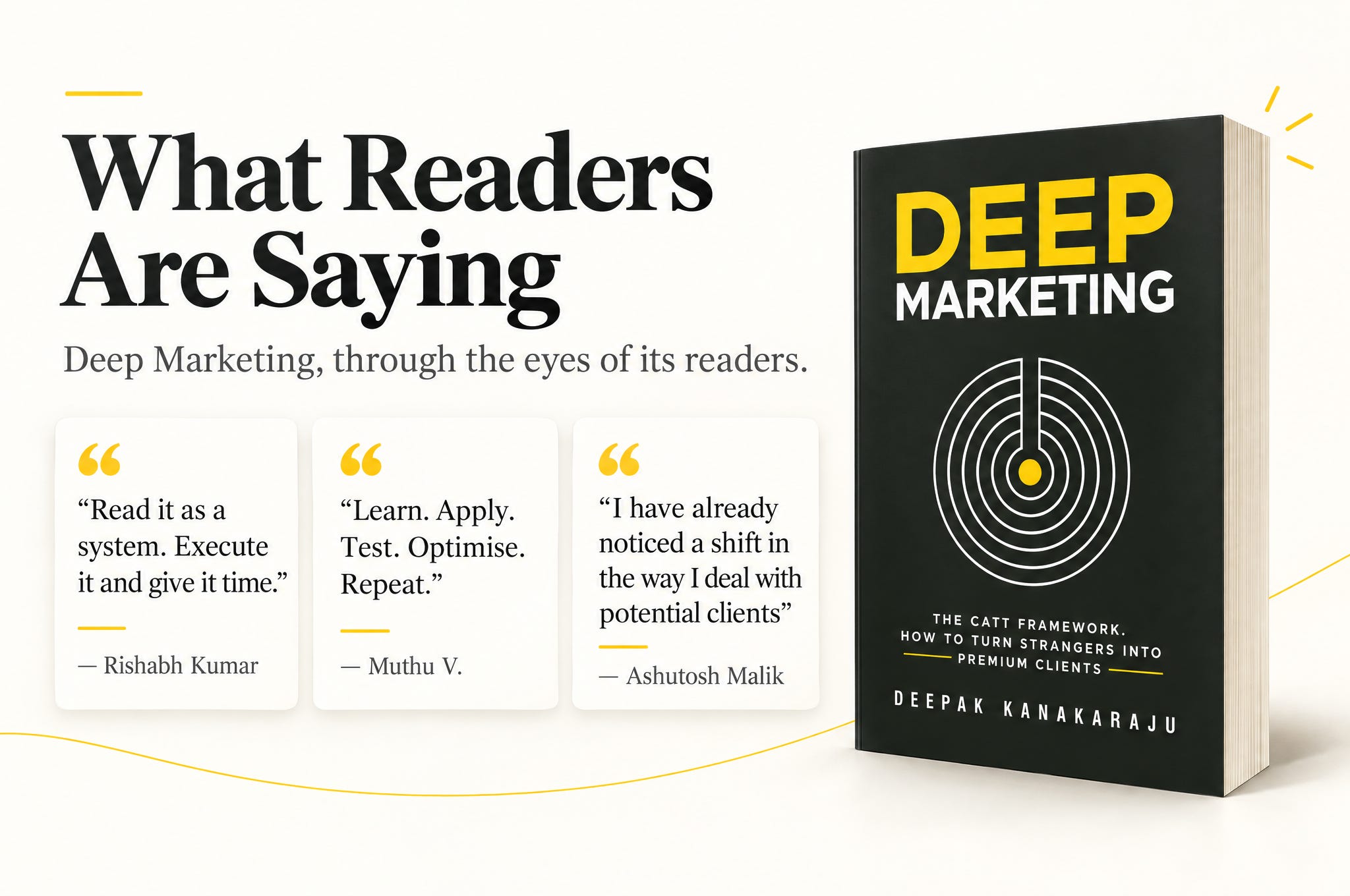
There are early signs of that movement in the reviews. One reader said they had started working with CATT to build their brand on social media. Ashutosh Malik reported noticing a shift in how he dealt with potential clients.
I am interested in hearing how those experiments develop. The next layer of feedback will come from what readers try, what proves difficult and what they learn while applying the ideas to their own circumstances.
The comments about the book’s design were specific too.
Chandan Kumar said the illustrations helped him understand and remember concepts, particularly when returning to key ideas. Swapna appreciated the black-and-white drawings and the breathing space on the page. Lalitha described the illustrations as visual anchors.
Those observations explain why presentation matters. Readers are describing how the visual structure helps them stay with an idea and find their way back to it later.
Sasi Ram kanna offered one of my favourite comments:
“I was never a nonfiction reader, but this is the book that made me finish one.”
He attributed that experience to the simple language and relevant examples. That is valuable feedback for any author trying to make a subject accessible. Finishing a book creates the opportunity to see how its ideas fit together.
Muthu V.’s review added a longer perspective. He said he had followed my work since 2011 and saw the book as the outcome of years of learning, application, failures and refinement.
What he appreciated was the process of examining different ideas, testing them in business and developing an independent view of what is useful. He captured that process in five short instructions:
“Learn. Apply. Test. Optimise. Repeat.”
I was pleased that he also recognised the time involved. Rishabh Kumar made a similar observation: some advice asks for patience and consistency before meaningful results emerge. His recommendation was straightforward:
“Read it as a system. Execute it and give it time.”
That is a good way to approach Deep Marketing. Read it once to understand how the pieces connect. Then return to the part that speaks most directly to your current situation and work through the actions.
Perhaps you need to explain your value more clearly. Perhaps prospective customers need more evidence before they feel ready. Perhaps your greatest opportunity is to improve what happens in the first week after someone pays.
The reviews I have shared here show readers asking more specific questions about their businesses. As an author, that gives me a great deal to be grateful for.
Thank you to everyone who has taken the time to describe what stayed with you. If you have read Deep Marketing, I would love to hear which idea made you pause, what you have tried, and what happened when you put it into practice.