

In 1895, John Deere wasn’t even a tractor company yet.
They sold steel ploughs. And that year they did something that made no sense to anyone in the equipment business.
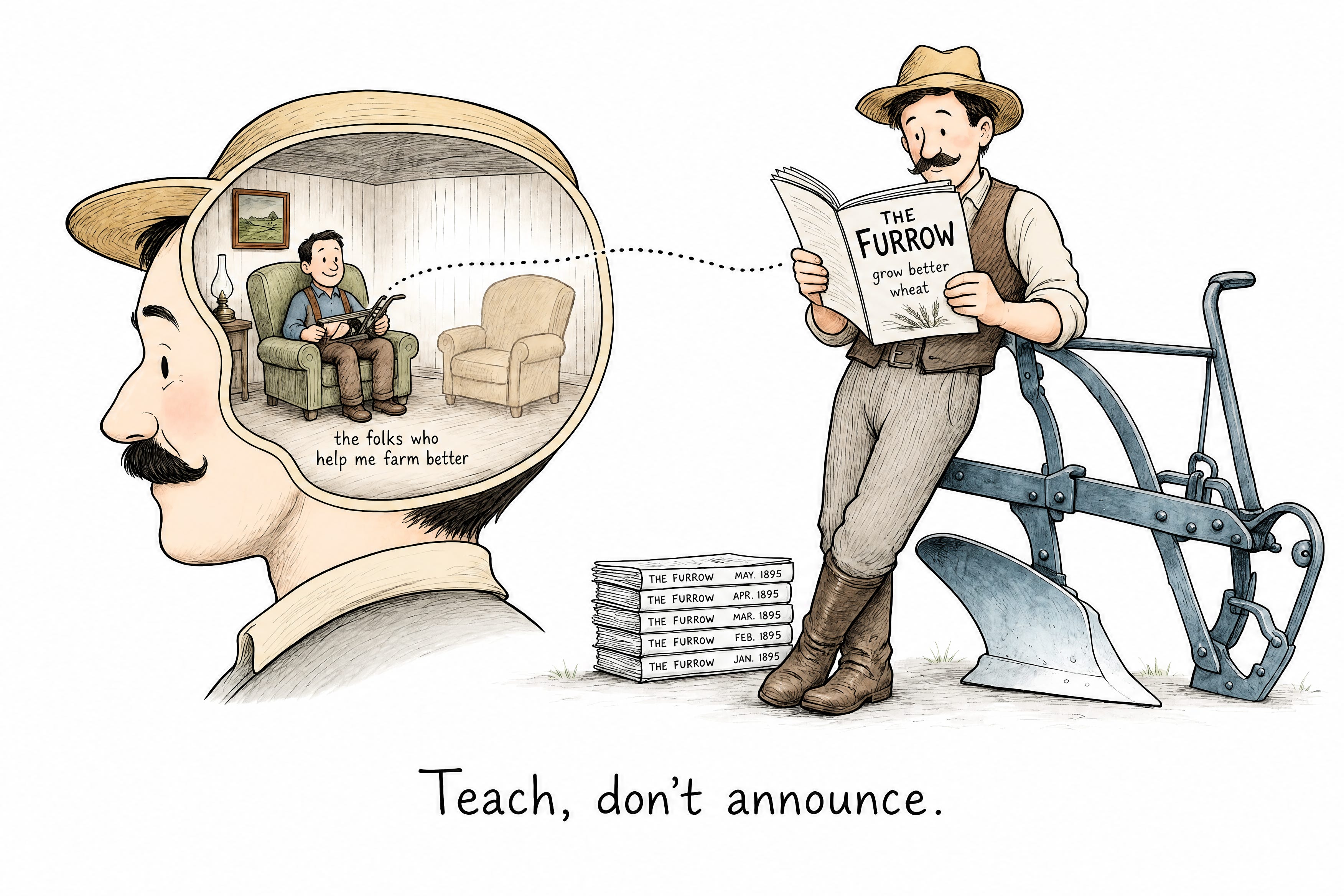
They started a magazine.
It was called The Furrow. And it wasn’t about John Deere. No product pitches. No price lists. It taught farmers how to farm. Healthier soil. Better yields. How to run a farm like a business instead of a gamble.
Farmers didn’t treat it like marketing, because it didn’t behave like marketing. They treated it like advice. They kept it. They passed it to their neighbours. By 1912, four million farmers were reading it.
Four million people. No internet. No email. No targeting. A plough maker had four million farmers voluntarily reading its message, and thanking them for it.
And when one of those farmers finally needed new equipment, whose name was already sitting in his mind? Not as a seller. As the people who help me farm better.
The Furrow is still running today. 130 years. Most ads don’t survive a week.
The company that sold tickets to its own ad
Jump forward 119 years.
In 2003, LEGO was dying. Biggest loss in its history. Edge of bankruptcy. A plastic-brick maker losing children to video games. Everyone knew how that story ends.
It didn’t end. New management saved the balance sheet. But the move that turned a recovered company into the most loved brand on earth was not an ad campaign.
In 2014, LEGO released a feature film. Two hours of bricks.
Call it what it is: an advertisement. And people queued up and paid money to watch it. Nearly half a billion dollars at the box office. That same year, LEGO overtook Mattel and became the biggest toy company in the world.
Read that again. John Deere’s content was so useful that farmers kept it for decades. LEGO’s content was so entertaining that customers bought tickets to the commercial.
Different century. Same law. Make the marketing worth the audience’s time, and the audience comes to you.
Same move, 119 years apart
A plough maker in 1895 and a toy maker in 2014 found the same truth. Content that serves the audience beats content that serves the company. Every time.
John Deere taught. LEGO entertained. Neither one shouted “buy.” Both built something people wanted, kept and shared. Both walked away owning the most expensive real estate in business: a seat in the customer’s mind.
That’s the C in my CATT framework. Content, Attention, Trust, Transaction. Content is where the machine starts.
And I’m not repeating borrowed theory here. I built my entire career on this one letter. I work four hours a day, four days a week, and clients still come looking for me. Not because I’m the loudest guy in the room. Because for over a decade, I’ve been the guy whose content people keep.
Most experts run this exactly backwards.
The catalogue problem
Open LinkedIn and look at what most consultants, coaches and freelancers post. It’s about themselves. Their services. Their certifications. Their “3 slots open for August.”
That’s not content. That’s a catalogue. Nobody reads catalogues.
Nobody woke up this morning hoping to hear about your offer. Plenty of people woke up with the problem you solve. Content works when it’s useful to your reader even if they never pay you a rupee.
I can hear you already. “Deepak, if I teach them everything, why would they hire me?”
I felt that fear too. Then I taught everything anyway, and my income went up, not down. Here’s why.
People don’t pay for information. Information is free. Every fact you know is one search away. People pay for implementation. For certainty. For a person they already trust to walk them through it. The more you teach, the more they trust you to be that person.
The farmer who read The Furrow didn’t say, “Wonderful, now I’ll build my own plough.” He said, “These people understand farming. I’ll buy from them.” Your reader works the same way. Teaching doesn’t make you replaceable. It makes you the obvious choice.
The Furrow test
Here’s a filter. Use it before you publish anything. One question:
If this person never hires me, is this still worth their time?
If yes, publish it. You made a Furrow.
If no, if the piece only exists as a step toward your pitch, you made a catalogue page. Into the bin it goes, and your credibility with it.
The farmer kept the magazine on his shelf for years. Be honest. Would anyone keep your last post?
Teach, don’t announce
That one shift puts you ahead of 90% of the experts in your field, because 90% of them are still announcing. I’ve watched them do it for years. They post catalogues, get ignored, and blame the algorithm.
The algorithm is not your problem. Your content is.
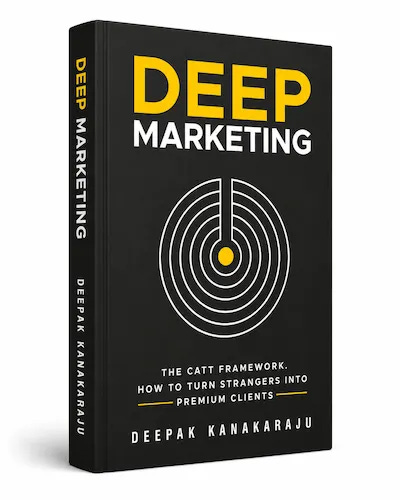
And teaching is only the first layer. Knowing that you should teach is easy. Knowing what to teach, how much, in what order, and how it quietly turns readers into paying clients, that’s the craft. I spent a full chapter of Deep Marketing on it, and I held nothing back:
The one type of content that builds trust faster than everything else. Most experts avoid it because it feels too simple.
Exactly how much to give away for free, and where the line actually is. Yes, there is a line. It isn’t where you think.
The content system that lets me publish every single week while working four hours a day. I’ve run it for over ten years. It has never stopped working.
And what to do if you hate writing. There’s a way around it that nobody talks about.
Get my book…
Cheers,
Deepak
P.S. In 130 years, The Furrow has never once shouted “BUY A TRACTOR.” LEGO’s ad was so good you paid for the ticket. That restraint is the whole game. I’ll show you how to sell without ever sounding like you’re selling. First page of the Content chapter.