

Two experts walk into a market.
The first is genuinely excellent. Fifteen years at the craft, the kind of judgement that lets her see in four minutes what somebody else would miss in four hours. She does careful work and she is quietly certain that if she keeps doing it, the world will eventually come to her.

The second is not especially good. Not at the craft, and not particularly bothered about the client either. But he is comfortable doing things she finds embarrassing. He is on somebody’s stage most weeks. He has opinions and he shares them loudly.
You already know which one has the premium clients.
The usual explanation is that he is louder, and that being louder wins. I believed that for a long time and it made me faintly miserable, because the only instruction it produces is to become somebody you are not.
It is also not quite right.
What your buyer is actually doing
Think about the last time you bought a mattress.
You lay on it for ninety seconds in a shop, and then you slept on it for eight years. Nobody in the history of mattresses has ever evaluated one in a shop. What you actually evaluated was the shop. The salesman. The other people buying there. The price, and what it seemed to promise.
Your client is doing exactly that with you, and it is not laziness. It is the entire reason they are hiring an expert in the first place. If they could judge the quality of the work, they would not need you to do it.
So they cannot assess your craft. They assess the things around your craft.
And that is the actual difference between the two experts. He is not winning because he is loud. He is winning because he is judgeable, and she is not.
Proxies, cheap and expensive
Everything a buyer uses to guess at quality is a proxy. Some are cheap and some are expensive, and the difference matters enormously.
Cheap proxies can be acquired in an afternoon. Confidence. A slick website. Volume. Being on a lot of stages. The appearance of being busy. Our loud expert has stacked up a great many of these, which is why he looks so much better than he is.
Expensive proxies take years and cannot be faked. A body of work somebody can actually read. A hundred people who will vouch for you unprompted. A book. Ten years of showing up in the same place saying useful things to the same audience.
Cheap proxies decay. They need constant topping up, which is why the loud expert can never stop, and why he looks tired if you meet him. Expensive ones compound, and they keep working while you sleep.
The good expert usually has neither. Not because she is incapable of building the expensive ones, but because she has been putting all her hours into the one thing that is not a proxy at all.
The part nobody enjoys hearing
Your craft is invisible.
Not undervalued. Not underappreciated. Invisible, in the specific sense that a person choosing between you and somebody worse has no way of perceiving it before they commit.
You have spent years getting better at something your buyer physically cannot see, and then felt aggrieved that they did not notice. I did this for most of a decade and I would have argued with anybody who suggested it.
It should not be that way. It almost feels unfair. But unfair does not pay the bills, and the market is still not choosing you.
Which is oddly good news
Because it means the instruction was never “become louder.”
The instruction is to build things a stranger can use to judge you before they have met you. And that turns out to suit the careful expert considerably better than the loud one, because the expensive proxies are made of exactly what she already has and he does not.
A body of work is just your craft, written down. People who vouch for you are just clients you served properly. A book is fifteen years of judgement, made visible.
She has the raw material. She has simply never converted any of it into a form anybody outside the room can see.
Which one are you?
I built something that tells you, in four minutes.
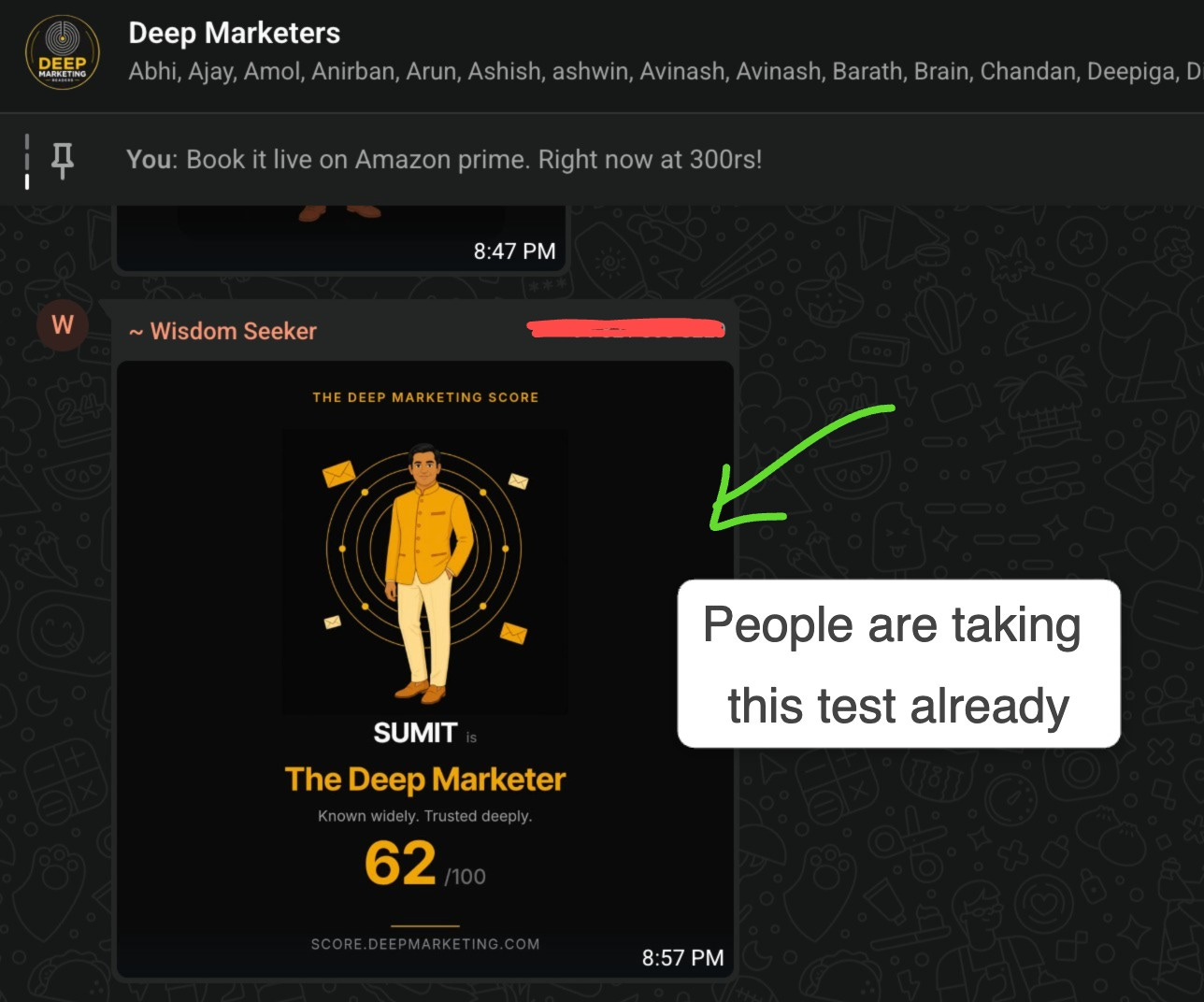
Twenty-one statements about how you actually win clients. At the end you get a score out of 100, which of four types you are, and seven parts of your marketing ranked worst first, so you can see the one that is capping the other six.
Most people find it is not the part they assumed.
Fair warning. Most people score lower than they expect. That is deliberate, because a test that tells everybody they are doing fine is a pleasant way to waste four minutes.
Nobody sees your answers, which helps.
Deepak