

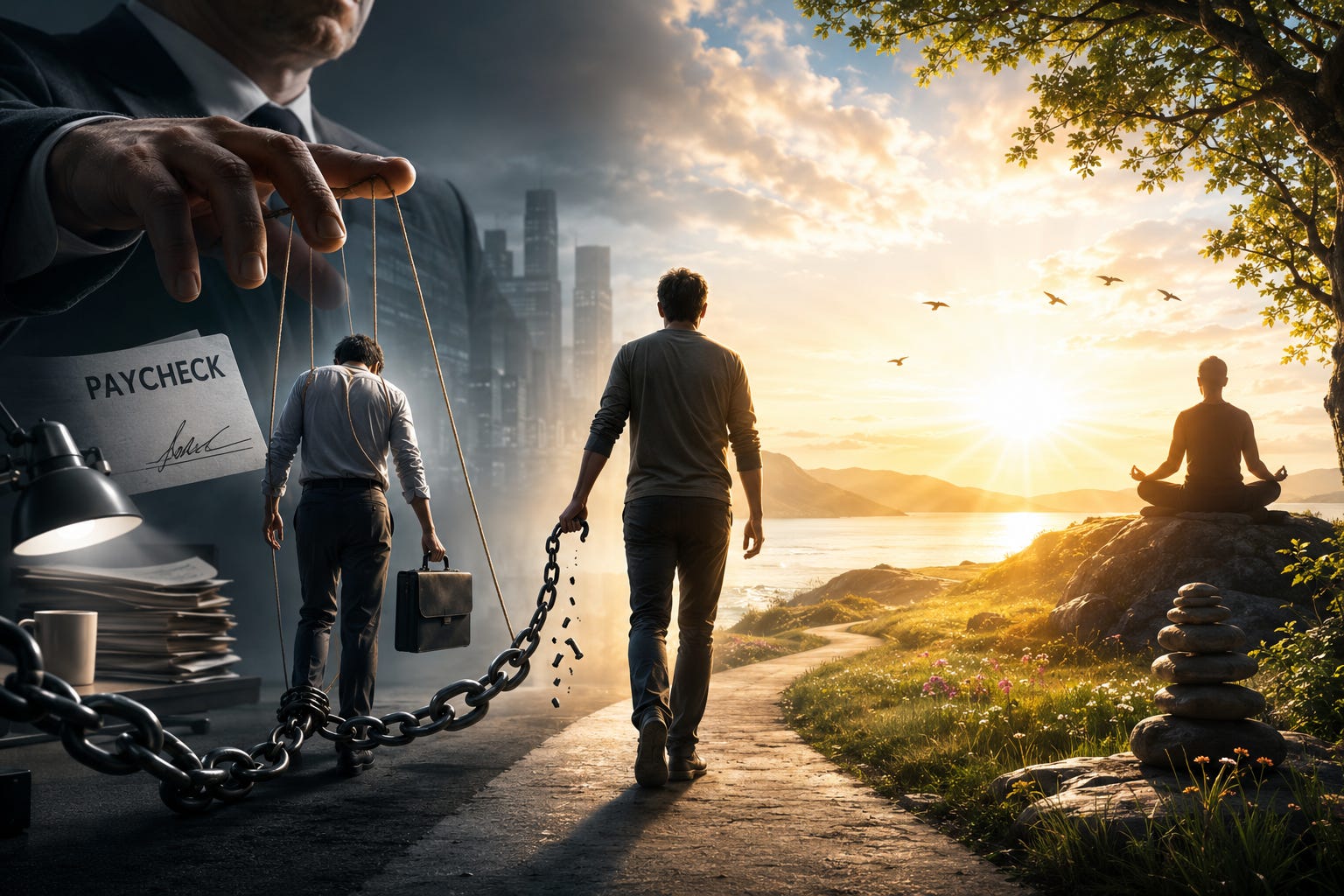
There are millions of bosses on this planet. You hate exactly one of them.
Sit with that for a second. Somewhere right now a man is barking at his employees, and you feel nothing about him. Across town, a man signs the checks and decides who gets promoted, and she doesn’t cost you a moment’s sleep. They have power. They use it. And you are completely indifferent - because you need nothing from them.
The boss you resent is the one whose signature is on your paycheck.
We tell ourselves the resentment is about power: someone has more of it than we do, and that’s the injury. But power alone provokes nothing. What provokes us is the particular person whose power sits on top of something we need. The hatred and the need are the same coin. You can’t have one without the other.
You didn’t lose your power. You lent it.
Here’s the uncomfortable reframe. We talk about the powerful as if they took something from us. They didn’t. We handed it over - willingly - in exchange for something we wanted.
An employee doesn’t merely suffer a boss. An employee needs the boss, because without him there’s no job, and without the job there’s no salary, and without the salary there’s no rent. The boss’s power over you is exactly the size of your need for what he provides. Shrink the need and the power shrinks with it. Eliminate the need entirely and the “powerful” person becomes just another stranger you feel nothing about.
So the resentment we aim upward is, quietly, a debt we took out ourselves. We gave someone authority over our days because we needed the one thing they could give us.
“Strong and independent” is a change of creditor, not freedom
Take the modern ideal of the strong, independent woman. A century ago, a woman with no path to her own income usually married, and many felt the cost of it sharply: no say in the big decisions, no money of her own, not even the freedom to move around as she pleased. To hand your power to one person is to lose the right to decide. That suffocation is a large part of what lit the feminist revolution - a refusal to be ruled by a single man.
But notice what the escape actually was. The woman who decides she will not depend on a husband does not thereby depend on no one. She depends on a boss instead. Male boss, female boss - it makes no difference. The power still gets handed over, just to a different address.
This isn’t an argument against independence; it’s an observation that pure independence is a fiction for everyone, men included. You don’t get to choose whether you depend on others.
You only get to choose your poison - whom you depend on, and how many of them there are. The dream of needing no one is the one thing no career and no relationship will ever deliver.
Climb the ladder and you don’t escape bosses - you collect them
We look up the ladder and imagine the people at the top are free. They aren’t. They just have more bosses.
A CEO looks powerful until you remember he answers to his customers, who can leave; to his investors, who can pull out; and to his own employees, who can walk. The founder feels this most honestly. There’s a reason the oldest joke in startups is: I quit my job to escape my boss - now I have a hundred of them. Every customer is a tiny employer. Every investor holds a piece of your leash.
Keep climbing. The leader of a nation seems like the most powerful person in the country - until you notice the enormous, distributed power sitting directly above his head: the citizens. Millions of them. He serves at their sufferance, and some part of him knows it. It’s why people in power are never quite as comfortable as they look.
The strange upside: more bosses can mean more freedom
Here’s the twist inside the twist. A distributed set of bosses is often better than a single one - provided you do your job.
If you have one boss and he’s irrational, you’re trapped. You can do everything right and still be at the mercy of his moods. But if you run a business with ten clients and one of them is a nightmare, you can fire that client, because the other nine will carry you. Distributed power is replaceable power. One bad customer in a sea of good ones is a rounding error. One bad investor among many can be bought out and forgotten.
This is why, counterintuitively, a consumer business with thousands of customers can be a calmer place to stand than a tiny shop with three clients who hold your fate in their hands. The wider you spread your dependence, the less any single person owns you - as long as you keep delivering value.
But spread power can still converge - and then it removes you
That last clause is the whole game. Distribution protects you only while you do your job. Stop delivering, and the many you depend on will eventually find each other.
This is the thing every ruler fears most: not a strong rival, but ordinary people deciding, all at once, to act together. A single citizen is powerless. Citizens combined are the most dangerous force on earth, and history keeps proving it.
In 2022, Sri Lanka’s president fled his own palace as protesters poured through the gates, a collapsed economy behind them. In 2024, a prime minister who had ruled Bangladesh for the better part of two decades boarded a helicopter and left the country as a student-led uprising swept the capital.
A decade before that, the Arab Spring toppled strongmen who had seemed permanent - Tunisia’s president, in power twenty-three years, gone in weeks; Egypt’s, after thirty, forced out by a single square full of people.
Go back to 1989 and watch the footage of Romania’s dictator on his balcony, mid-speech, the instant the crowd’s cheers curdle into boos and he realizes, live on camera, that it’s over.
Even where the change is peaceful and procedural, the principle holds: in my own corner of the world this year, a party barely two years old swept aside a duopoly that had run Tamil Nadu for nearly six decades, simply because enough people walked into a polling booth and decided the powerful had stopped serving them.
The lesson is constant. You can hold enormous power right up until the people above your head conclude you are no longer doing your job. Then no army of advisers can save you.
It cuts the other way too. There are leaders whose citizens genuinely back them, founders whose employees respect them because they’re seen as the hardest worker in the building, husbands and wives who love rather than resent each other - and in every case it’s because the duty is being honored.
We extend our power on trust. Love is what the arrangement is called while that trust holds. Hate is what it becomes the moment the power is abused.
It was never about power. It was always about need.
Strip away the layers and the same engine is running under all of it. Marriage, employment, politics - every one of them is a structure built on need.
You need a government to guard the borders, manage the money, and keep a country coordinated, so you hand it authority - and then you grumble when its motorcade blocks your commute, because you trusted it not to lord that authority over you.
You need a salary, so you hand your boss your weekdays. You need companionship, so you hand a spouse a claim on your life. The amount of power someone has over you is simply a readout of how much you want from them.
And the more you want, the more of you they own.
The most powerful person alive wants nothing
So here is where it lands, and it’s the opposite of where you’d expect.
If power is borrowed against need, then the freest person in the world is the one who needs nothing at all. The sage. The Buddha. He forms no dependency because he wants nothing, and because he depends on no one, he has no boss - no customer, no investor, no spouse, no citizenry to answer to. He can’t be overthrown, because he asked for nothing in the first place.
The only truly free person is the one who wants nothing. And freedom is the highest power there is.
This is what the Buddha meant, twenty-five centuries before the first quarterly earnings call: desire is the root of all suffering.
We suffer precisely because we want - and wanting is the very act of placing someone above us. The CEO who doesn’t need the money is untouchable by demanding customers. The politician who doesn’t crave the power doesn’t fear the crowd. The person who is genuinely content alone has handed no one the keys to their happiness.
In each case the freedom flows from the same source: the absence of want.
We are not Buddhas - and that’s the honest part
But let’s not pretend. You and I are not going to renounce everything and sit under a tree. Human life isn’t built for it. Even Tom Hanks, marooned and alone in Cast Away, couldn’t hold serene isolation for long - he painted a face on a volleyball just to have someone to talk to.
As long as you are alive and human, you will want things, and wanting things means depending on people, and depending on people means handing over some of your power. There is no clean exit.
So this isn’t a call to abandon your job, your marriage, your ambitions. It’s a quieter instruction.
Every desire you can genuinely loosen is a small repossession of yourself. You will never get the number of your bosses down to zero - but you can get it lower. You can want a little less, and owe a little less of yourself in return to someone else in power.
Next time you feel that hot flash of resentment toward someone with power over you, don’t ask how to seize their power. Ask the more useful question: what do I want from them - and could I want it a little less?
Because that, in the end, is the only boss you can ever actually quit - the one doing the wanting.
The freest people want nothing at all!! So nicely said! Loved this read Deepak
Another amazing article, DD!