

I have a hobby that most people would find boring.
I funnel hack coaches.
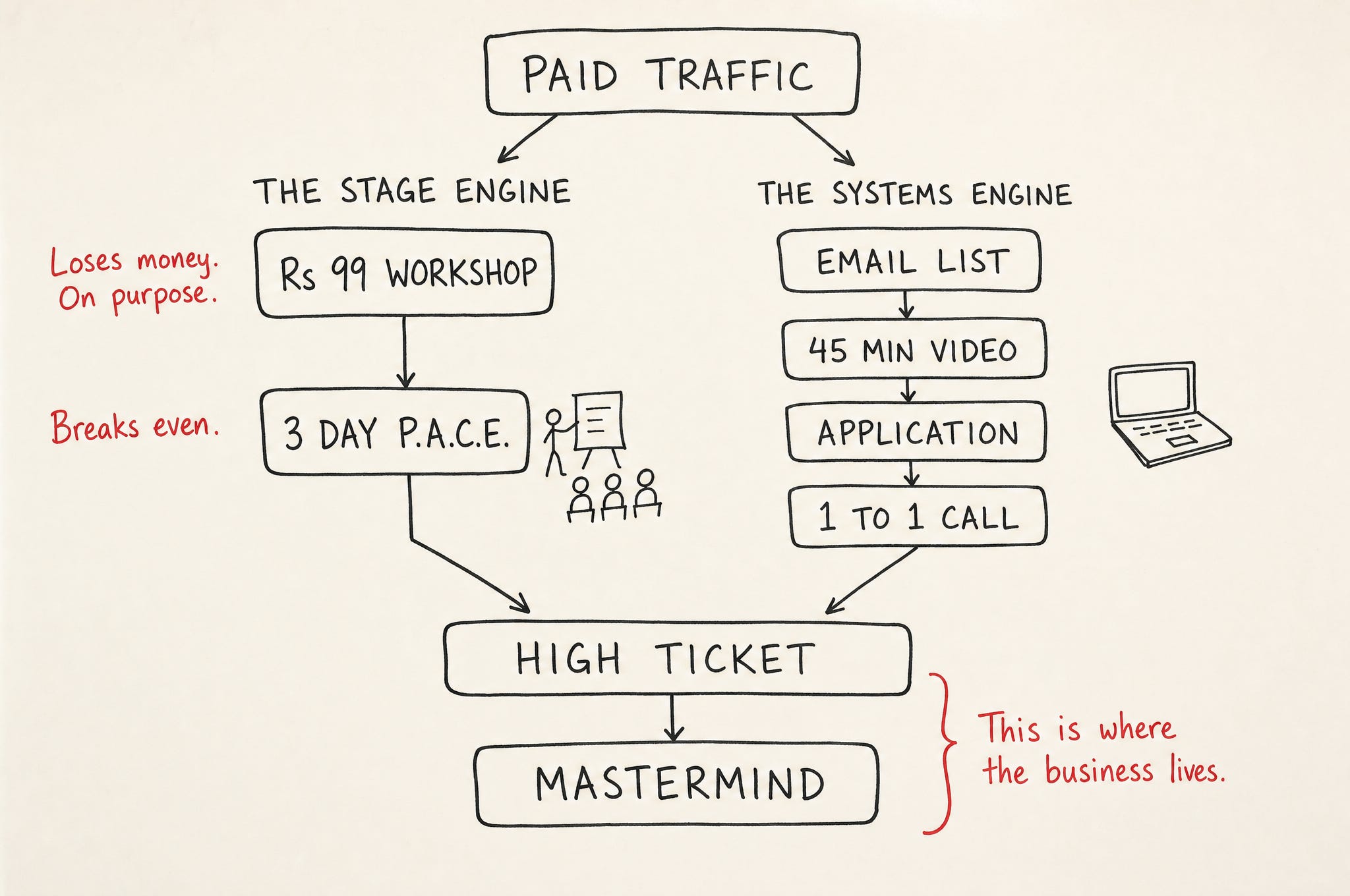
Not to copy them. To understand them. I buy the programs. I sit in the rooms. I open the Facebook ad library and read every creative. Then I draw the whole thing out as a flowchart until I can explain to myself exactly where the money comes in, and exactly what the customer thinks he is buying.
Most businesses in this industry, I can map in one sitting. The pattern shows up by the second layer. Ad, webinar, three day event, high ticket, done.
Rajiv Talreja’s business took me years.
And when I finally saw it, my first reaction was not admiration. It was irritation. The good kind. The kind you feel when someone has quietly solved a problem you did not know could be solved, using a method that was sitting in the open the entire time, and you walked past it four times.
Let me tell you what I think it is. I have not seen anyone write this down, including people who have paid to be in that room.
Almost everybody in this business sells opportunity. Rajiv sells a diagnosis.
Start here, because everything else follows from it.
Most high ticket education in India sells opportunity. Mine has, at times. You paint a future the person does not currently have, you make it feel close enough to touch, and you sell the vehicle that gets him there. Build a business around your passion. Become a coach. Sign global clients. Quit the job.
It works, because income is the highest demand product in a country like ours. Nothing else comes close.
It is also the most fragile ground you can stand on. The promise is in the future, the buyer cannot verify it today, and you are asking him to buy hope. Hope is expensive to keep in stock.
Rajiv is not doing that.
He sells to people who already have a business. Not dreamers. Not “I want to start something someday.” Real operating MSMEs. Manufacturers, retailers, clinics, CA firms, staffing companies, workshops. Businesses that are twelve years old, twenty years old, thirty five years old, with staff and salaries and a GST filing every month.
You cannot sell opportunity to a man who has run a factory for thirty years. He has heard every version of it, from every stage, in every city. He is vaccinated.
So Rajiv does not try.
He measures him instead.
The gap is the sale
Here is the engine. I would bet money that most people who sat through those three days could not name it.
P.A.C.E. is not a course. It is a diagnostic instrument.
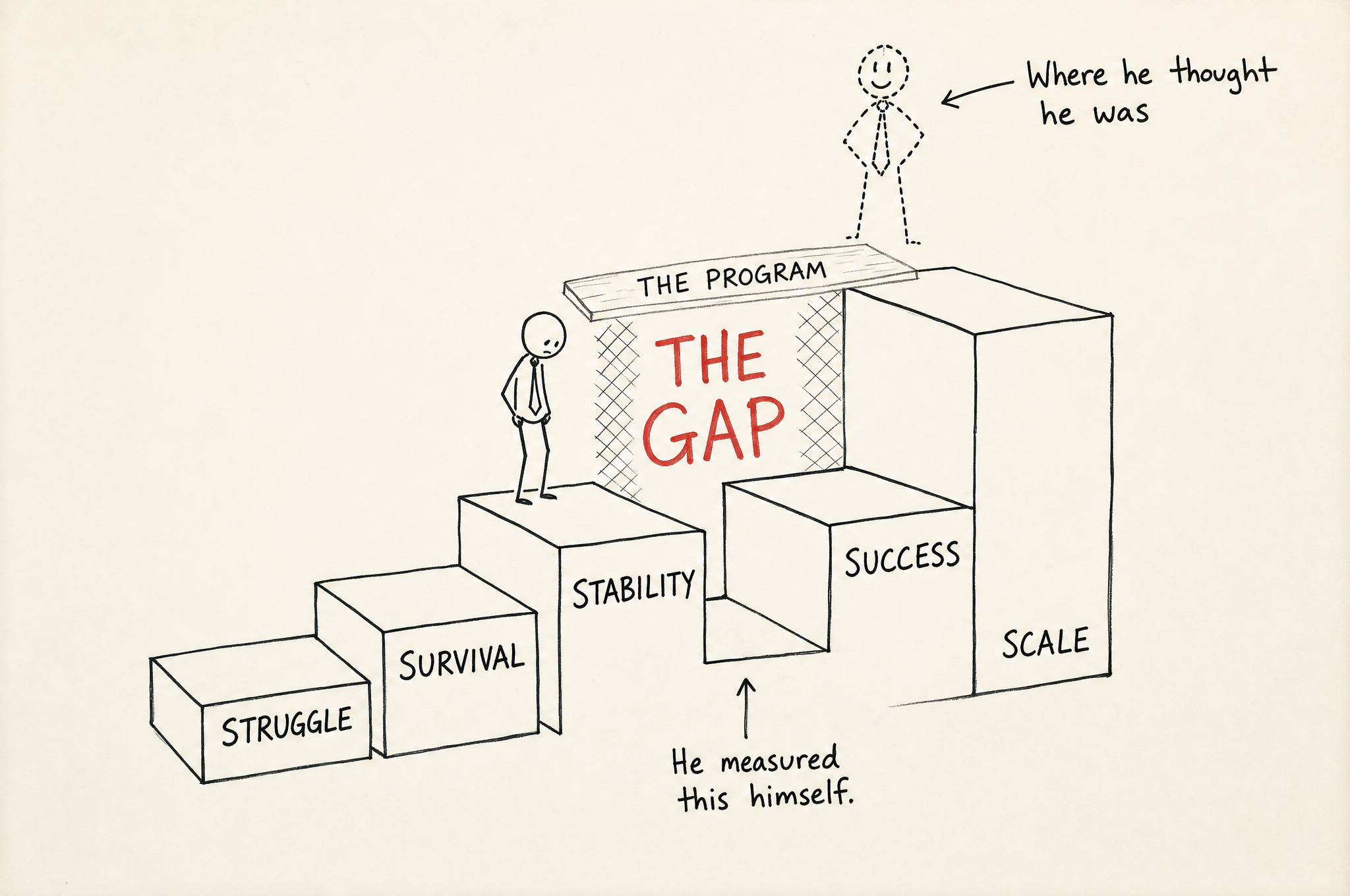
Over three days the business owner is walked through a structured assessment of his own company. The stages of a business, struggle to survival to stability to success to scale. The functions. The management system. Role clarity. Review rhythm. None of it is delivered as information. All of it is delivered as a measuring device, and the owner applies it to himself, live, using his own numbers.
By the middle of day two he has not been persuaded of anything. He has calculated his own gap. He knows where his business actually sits, which functions are leaking, and how far that is from where he had been telling himself he was.
Now watch what happens.
Nobody has pitched him. And the sale is already made.
Because a measured gap creates its own urgency. You can argue with a pitch. You cannot argue with your own arithmetic. The higher programs then arrive not as an offer but as a bridge, and the bridge is standing over a canyon the man measured himself.
This is why that room converts owners who have ignored every coach who ever ran an ad at them. They are not being convinced. They are being diagnosed. And a good diagnosis buys the person delivering it an enormous amount of authority, instantly, which is why you keep hearing the same sentence from people walking out of there, in different words. It felt like he had been sitting inside my company.
He has not. He has built an instrument sharp enough that a hundred different owners each see their own reflection in it, in uncomfortable detail.
I want to say the commercial part plainly, because this is the bit worth stealing. The content and the pitch are the same object. There is no value section followed by a sales section. The diagnosis is the value, and the diagnosis is also what makes the next program obvious. That is very hard to design. I have not seen anyone in India do it at this level.
The front end is not supposed to make money
The second thing that took me too long to respect is the discipline of the ladder.
The ninety nine rupee workshop does not make money. It cannot. In this ad market, acquiring somebody willing to pay ninety nine rupees costs many times ninety nine rupees. It exists for exactly one reason. Free registrations do not show up, paid ones do. That ninety nine buys attendance, and attendance is the actual product at that stage.
The three day program is not the margin either. It is where trust gets built at a depth no webinar can reach. Nine, ten hours a day, three days running. That is not content delivery. That is immersion, engineered on purpose, so the diagnostic can run properly and so the man has enough time to arrive at his own verdict instead of being handed one.
Everything before the high ticket is a deliberate investment in attention.
Most operators cannot hold their nerve through two loss making layers. They get scared, they raise the front end price, they choke their own funnel. Rajiv has held it for over a decade, and he has not repositioned the brand once. In this industry that is close to unheard of.
He runs two funnels, not one
This is the observation I am most confident nobody talks about.
The workshop ladder is only one of his engines. There is a second one running beside it, quietly. A video sales letter funnel that takes people off the email list, into a long video, into an application, into a one to one conversation, and straight into the high ticket program without a live event anywhere in sight.
Why build both?
Because the best customer for a two lakh program is often the worst candidate for a three day live event. He is busy. He cannot hand over a weekend.
I am that guy. I have paid for P.A.C.E. twice, once offline and once online, and both times life pulled me out somewhere around day one and a half. Under a pure workshop model I am a dead lead. The second funnel exists to catch people like me.
Running both is rare, because they need opposite men. The live ladder needs a performer. The video ladder needs an operator managing traffic, applications, sales and account management every single day. Almost everybody picks one and tells themselves the other one does not work.
Three architectures, three different bills
Two of the sharpest operators in this market are friends of mine, so let me be careful and honest at the same time. My point is not that one model wins. Each one buys something, and each one sends a different bill.
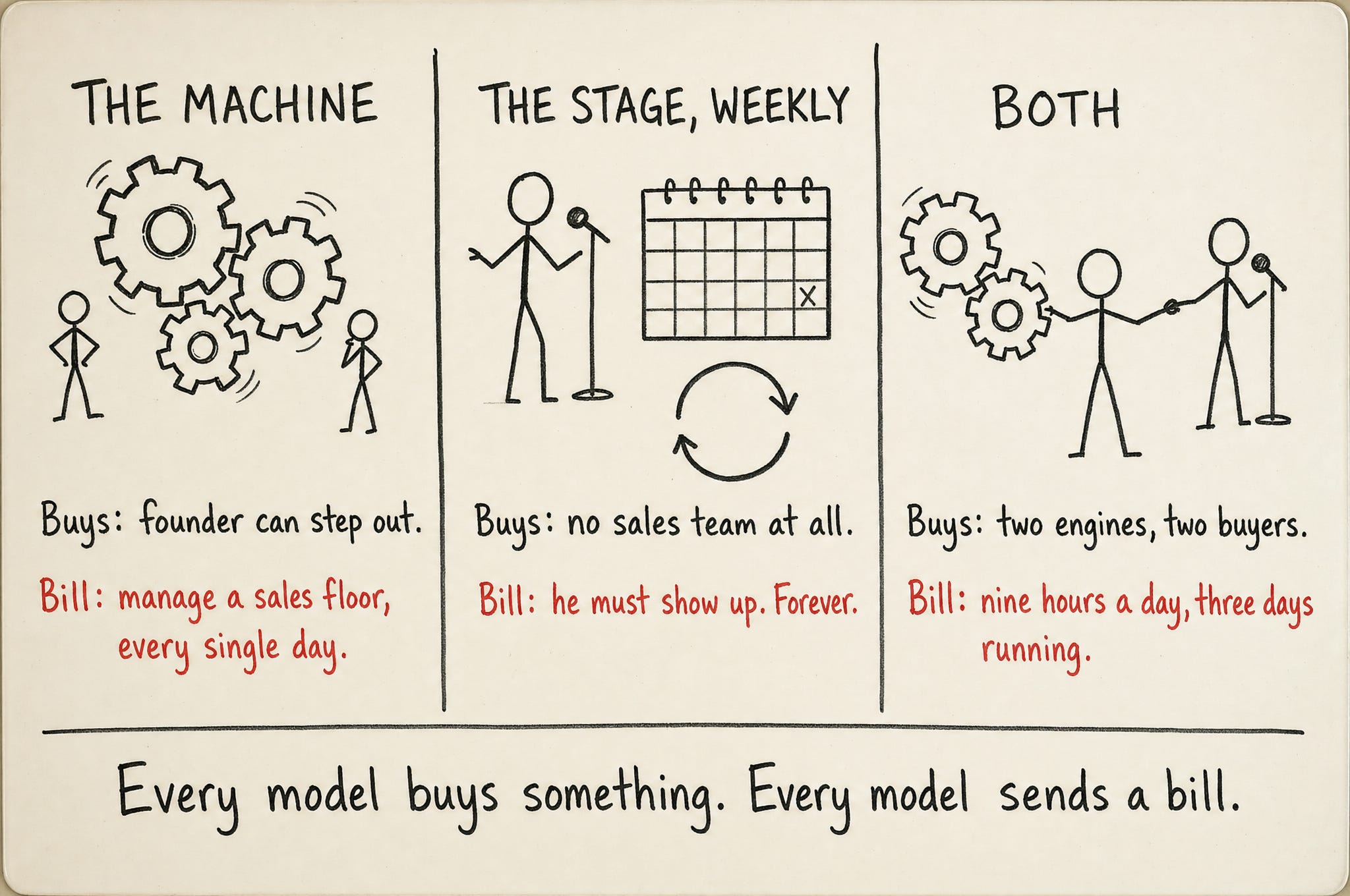
Rohan and the UAbility team have built the most automated of the three. Traffic, video, application, one to one close. On paper it is the simplest funnel in the country, and I say that as their customer. What people miss is that the simplicity is front loaded. The difficulty just moves to the sales floor and the account management floor, and the founder trades stage time for daily team management. It is also the only one of the three where the founder could eventually be replaced. That is a genuine strategic asset and most people do not appreciate it.
Siddharth has built the exact inverse. No sales team at all, for programs at one to three lakhs, which sounds impossible until you understand why it works. By the time somebody reaches that decision he has been receiving value from Sid for months. He is pre sold, and more importantly he is forgiving, because the earlier tier already over delivered. His public reputation is the proof of the design, not an accident of it. The bill he pays is that he has to show up personally, several days a week, forever. The business does not exist without him in the room.
Rajiv pays a third bill. He carries the stage and the team. And he has one thing the other two models do not require at all. Founder product market fit. Not product market fit, founder fit. The ability to hold a room at full voltage for nine hours a day, three days running, again and again.
I know for a fact I cannot do that. If I tried it once I would need a quarter to recover.
You cannot copy that. It is not a strategy, it is a physical asset, and it is why the model is defensible in a way a funnel never is.
What I am taking with me
Three things. I am saying them out loud because I intend to use them, and I would rather tell you than pretend I arrived at them alone.
One. Build a diagnostic, not a curriculum. The most valuable thing you can hand a customer is an accurate measurement of where he actually stands. It converts without pressure, it earns you authority in the moment, and it makes your next offer obvious instead of pushy. I have been building courses when I should have been building instruments.
Two. Your front end is not there to make money. It is there to buy attention at a price you can sustain. Most people kill their own funnel trying to make the first layer profitable.
Three. Sell to people who already transact. Every hard thing in this business, proving results, collecting real testimonials, not being pushy, gets easier when the customer already has revenue to measure against. Selling to people who already run something is the best substitute for pressure tactics I have found.
There is a version of this industry that runs on noise, and a version that runs on measurement.
Rajiv has been building the second one for over a decade, in a market that mostly pays for the first.
Go find your instrument.
Deepak
Hey Deepak,
Amazing analysis as how you see from Inspect and Adapt perspective. This is priceless wisdom flowing as a stream and creating an awareness on where the attention investment be for both founders and customers. Thanks for this insightful read.