

They scroll through Instagram. They watch YouTube videos. They listen to podcasts while driving or working out. Even people who love buying books often have a shelf full of titles they have not finished.
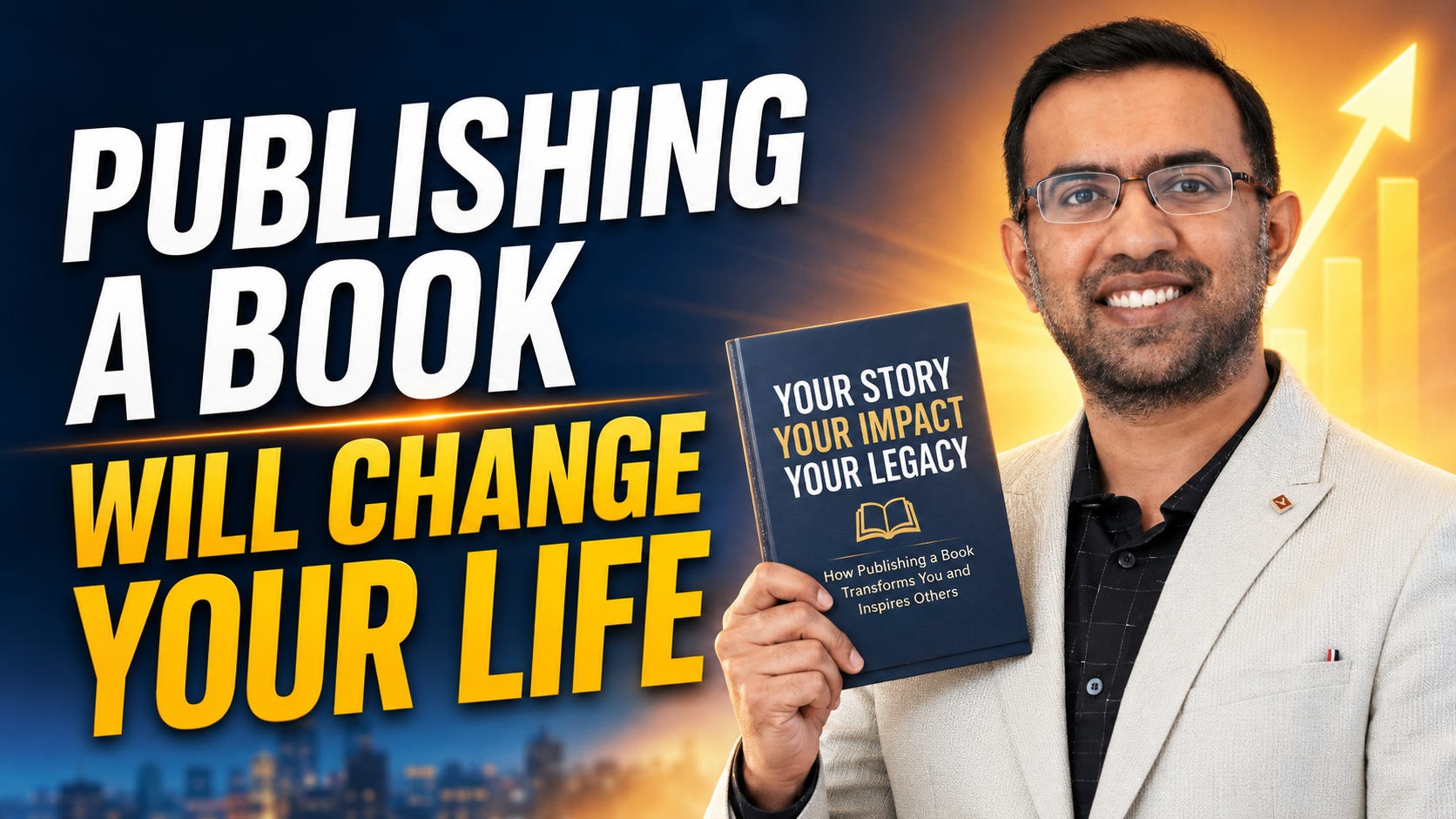
So you might ask: What is the point of publishing a book today?
That is a reasonable question.
Writing a book requires effort. Once your words are printed, you cannot casually delete them the way you can delete a badly performing reel or rewrite a social media caption. A physical book feels permanent. That permanence makes many people hesitate.
[Watch a video version of this blog post]
But that is also precisely why a book matters.
A book is not just a container of information. It is a credibility asset. It signals that you have thought deeply about a subject, structured your experience and taken the effort to put your name behind an idea.
People may not finish every chapter of your book. They may not even open it immediately. But when they hold a book with your name on the cover, they see you differently.
I learned this when I published my first book, Edge of Sanity, in 2018.
I did not publish it because I expected to become rich from royalties. I published it because I wanted to experience the process. I wanted to know what it felt like to call myself a published author and to hold a physical book with my name on it.
That experiment changed how I viewed books forever.
A book can become your best business card. It can sit on a prospect’s desk long after your sales conversation is forgotten. It can help a consultant, coach, freelancer or creator become more memorable. It can make podcast guests take an invitation more seriously. It can give a potential client a reason to come back to you six months later.
More than that, publishing your first book changes the way you see yourself.
This article is a detailed guide to doing it step by step.
First, Change the Way You Think About Your First Book
The biggest mistake aspiring authors make is believing their first book needs to be a masterpiece.
They imagine that every chapter must flow perfectly into the next. They think they need an extraordinary original idea. They believe they need to disappear for one year, write 80,000 words and come back with a life-changing manuscript.
That is not necessary.
Your first book can simply be a well-organised collection of your best thoughts, lessons, experiences and frameworks around one subject.
It could be:
A collection of lessons from building your business
A guide based on your expertise in marketing, fitness, design, investing, video production or consulting
Your personal story and the lessons you learned from it
A curated collection of your best blog posts, rewritten as chapters
A series of insights originally expressed through YouTube videos, podcast episodes or social media content
If you are over 30, you probably have a decade of lived experience that someone younger than you can learn from. Even your failures contain lessons. Even your experiments can help another person avoid wasting time and money.
Do not ask, “Am I important enough to write a book?”
Ask, “What have I learned that could help someone who is one or two steps behind me?”
That question is enough to begin.
[Watch a video version of this blog post]
Step 1: Decide the Strategic Purpose of Your Book
Before writing, decide what the book is supposed to do for you.
Some people publish books to earn royalties. There is nothing wrong with that. But for most entrepreneurs, consultants, coaches and creators, book sales are not the biggest opportunity.
The bigger opportunity is trust.
A book can help you:
Establish expertise in a specific niche
Start better conversations with potential clients
Give prospects a reason to remember you
Send something meaningful after a sales meeting
Get invited to podcasts, events or collaborations
Build a stronger personal brand
Turn your existing content into an enduring asset
For example, if you are a video editor, a book about video editing and production could make a client take you more seriously than a portfolio link alone. If you are a fitness coach, a practical book on sustainable transformation can give prospects confidence in your philosophy. If you are a marketing consultant, a book explaining your approach can act as a silent salesperson.
Your book does not have to make money directly to be commercially valuable.
Sometimes, one good client acquired because of the book can be worth more than thousands of book sales.
Your action step
Write one sentence answering this question:
After someone sees or reads my book, what do I want them to believe about me?
Examples:
“I want business owners to see me as an expert in generating leads through content.”
“I want aspiring freelancers to trust me as someone who has built a successful career independently.”
“I want fitness trainers to understand my system and inquire about coaching.”
That sentence becomes your compass for the entire publishing process.
Step 2: Pick a Clear Topic and Working Title
Do not begin with a vague book idea such as “I want to write something about life” or “I want to write about business.”
A good first book needs a clear theme.
Your topic should sit at the intersection of three things:
What you know through real experience
What your audience wants help with
What strengthens your positioning in the market
A consultant who wants clients should not randomly publish poetry just because publishing any book feels impressive. The book should reinforce what they want to be known for.
Once you know the topic, create a working title.
The title does not need to be final. Its purpose at this stage is to make the project feel real.
When I started working on my first book, creating the title and getting the cover designed gave me momentum. Until then, the book was an idea in my head. Once a cover existed, it began to feel like a real object I had to complete.
Simple title formulas
Try one of these patterns:
The [Desired Result] Method
[Specific Outcome] for [Audience]
The Art of [Skill or Transformation]
[Memorable Phrase]: Lessons on [Topic]
From [Problem] to [Outcome]
Examples:
The Client Trust Method: A Consultant’s Guide to Building Authority Online
Video Production for Business Owners
From Freelancer to Agency Owner
The Quiet Expert: How to Build Authority Without Becoming an Influencer
Your action step
Write down 10 possible titles. Do not overthink them. Choose the strongest working title and move ahead. You can refine it later.
[Watch a video version of this blog post]
Step 3: Create the Book Cover Early
Many writers treat the cover as the final step. For your first book, I recommend doing it early.
Not because you need the final print-ready design immediately, but because the cover creates emotional commitment.
When you see a title, your name and a design on a book-shaped mockup, the project no longer feels abstract.
You can use:
A professional freelance designer
A design marketplace
A trusted designer from your network
AI tools for early concepts and direction, followed by professional refinement for the final printable file
At this stage, you need to decide an approximate physical size for the book as well. Two common trim sizes for non-fiction books are:
5 x 8 inches
6 x 9 inches
You do not have to make this decision intellectually. Pick up a few non-fiction books you already own. See which one feels comfortable to hold. Measure it. That can become your starting format.
Remember: the cover must eventually be designed according to the exact page count, paper choice, trim size and spine thickness. So your early cover can be motivational; your final print cover should be created after the interior pages are ready.
Your action step
Create a simple front-cover concept with:
Working title
Subtitle, if necessary
Your name
A clear visual style aligned to the topic
Save it somewhere you can see it regularly. Let it remind you that the book needs to be finished.
Step 4: Mine the Content You Already Have
You probably do not have to begin with a blank document.
When I created Edge of Sanity, I did not start by writing a complete manuscript from zero. I went to my existing blog and took out roughly 40 blog posts on entrepreneurship.
I then looked at which posts had received the most engagement: comments, likes and shares. I organised them in a spreadsheet, ranking the strongest posts first. I removed a few pieces that did not fit or had weak traction. The remaining posts became around 35 chapters in my first book.
This method is powerful because the market has already given you feedback. If an idea resonated as a post, video or email, it may deserve a place in your book.
Today, creators have even more raw material available:
Blog posts
Email newsletters
YouTube transcripts
Podcast transcripts
Long-form LinkedIn posts
Workshop recordings
Course lessons
Voice notes about your experiences
Frequently asked client questions
If your strongest content exists in video form, get the transcript and use AI as an editing assistant to turn the transcript into structured written chapters. Do not simply dump an unedited transcript into a book. Spoken language has repetition, filler words and unfinished thoughts. The job is to extract the useful ideas and reorganise them into readable chapters.
If you do not have content yet, start producing source material now. You can speak into a voice recorder for 20 to 30 minutes on a specific question and then turn that raw thinking into an article or chapter.
Create your content inventory
Make a spreadsheet with these columns:
Content title or ideaFormatTopicAudience problem solvedEngagement or proof of relevanceUse in book?Example: How I got my first clientYouTube videoFreelancingFinding clientsHigh commentsYes
Collect 20 to 50 possible ideas.
Then ask:
Does this idea fit the central theme of my book?
Does it help the reader solve a real problem?
Does it reveal experience or insight unique to me?
Can it become a complete chapter?
Your first manuscript may already be hiding in your archive.
Step 5: Create a Chapter Outline
Once you have your raw material, you need structure.
A book does not need to be a perfectly continuous story. Your first book can be a collection of independent lessons. But the reader should still feel that the chapters belong together.
There are two simple ways to structure your book.
Option 1: A progressive guide
This structure moves the reader from beginner to outcome.
For example, a book on personal branding might have:
Why personal branding matters
Finding your niche
Understanding your audience
Creating your message
Writing content
Publishing consistently
Building trust
Turning attention into clients
Option 2: A collection of notes or lessons
This works when your chapters are based on articles, personal reflections or independent ideas.
For example:
The cost of waiting for permission
Why expertise is built in public
The difference between attention and trust
Why every entrepreneur should write
Building assets instead of chasing algorithms
The chapters are connected by a broad idea, even if each chapter can stand on its own.
How many chapters should you have?
A practical first non-fiction book could have 15 to 25 chapters. If each chapter is around 1,500 to 2,000 words, your manuscript can reach 30,000 to 40,000 words.
That is substantial enough to feel like a proper book without making your first publishing project unnecessarily overwhelming.
Some books are longer. Some are shorter. Your first priority is not thickness. Your first priority is finishing a coherent, useful book.
Your action step
Create a table of contents with 15 to 25 chapter titles.
Under every chapter, write three bullet points:
The problem this chapter addresses
The key lesson you want to teach
The personal story, case study or example you will include
Now your book has a skeleton.
[Watch a video version of this blog post]
Step 6: Write the Manuscript One Chapter at a Time
A book becomes intimidating when you think of it as “writing a book.”
It becomes manageable when you think of it as writing one useful chapter today.
If your outline contains 20 chapters and you write one chapter per day, you can have a raw manuscript within a month, even after allowing a few rest days.
Do not attempt to make every chapter perfect on the first draft. Your job in the first stage is to create material that can be improved.
A simple chapter structure
For most practical non-fiction books, this format works well:
Start with a problem or question the reader recognises.
Share a story, observation or experience that makes the idea human.
Explain the principle clearly.
Give a framework or step-by-step method.
End with an action step the reader can apply.
For example, if your chapter is called “Your Book Is Your Business Card,” you might:
Start with the problem of being forgotten after a networking event
Describe what happens to most business cards
Contrast that with handing someone a signed book
Explain the concept of physical remarketing and credibility
Suggest three occasions where the reader could send or gift their book
That is a chapter.
How AI can help without replacing your voice
AI can be useful for:
Converting a spoken transcript into a first written draft
Reorganising messy thoughts into an outline
Removing repetition
Correcting grammar
Suggesting headings
Checking clarity
But your book should still contain your experiences, your examples and your beliefs. Generic information may fill pages, but it does not build trust.
The reader does not need another book that sounds like a search result. They need the perspective of a real person who has lived through the problem.
Your action step
Create one master document. Add your title page and table of contents. Then write or revise one chapter at a time until every chapter exists in draft form.
Do not repeatedly rewrite chapter one while the rest of the book remains empty. Finish the entire rough manuscript first.
Step 7: Add the Supporting Pages That Make It a Book
A manuscript is more than its main chapters.
Once your chapter drafts are complete, add the pages that help the book feel professional and complete.
You may include:
Title page
Copyright page
Dedication, if desired
Table of contents
Preface or introduction
The main chapters
Conclusion
Acknowledgements
Author bio
Invitation to join your email list, visit your website or explore your services
For a business-oriented book, the final pages matter a lot. Do not turn the book into a sales brochure, but do give an interested reader a clear next step.
For example:
Invite the reader to subscribe to your newsletter
Point them to additional resources
Invite qualified readers to apply for a consultation
Mention where they can follow your work
Your book should continue the relationship after the final page.
Step 8: Edit, Proofread and Improve the Manuscript
This is where the book becomes credible.
Publishing a book with poor grammar, repeated ideas, unclear chapters or careless typos defeats the very purpose of building trust.
You do not necessarily need an expensive editorial process for your first experimental book, but you do need to take editing seriously.
Use at least three editing passes.
Pass 1: Structural editing
Ask:
Does every chapter belong in this book?
Are any chapters repeating the same idea?
Does the order make sense?
Is there a missing chapter the reader needs?
Is the promise of the book being fulfilled?
Pass 2: Clarity editing
Ask:
Are my sentences readable?
Have I explained technical concepts simply?
Have I included enough examples?
Have I removed unnecessary filler?
Is my voice consistent throughout?
Pass 3: Proofreading
Check:
Spelling
Grammar
Punctuation
Names and numbers
Chapter numbering
Headings
Formatting consistency
AI can help you spot errors, but do not blindly accept every suggestion. Read the full manuscript yourself. Ideally, have at least one other person read it before you approve it for print.
When you publish a social media post, you can edit or delete it. When hundreds of printed copies exist, correcting mistakes becomes much more inconvenient. Give proofreading the seriousness it deserves.
Step 9: Understand Typesetting and Interior Design
Many first-time authors think the job is done once the content is ready in a Google Doc or Word file.
It is not.
A digital manuscript needs to be turned into a properly designed book interior. This process is called typesetting.
Typesetting determines:
Page size and margins
Font family and font size
Line spacing
Paragraph spacing and indentation
Page numbers
Headers and footers
Chapter title layout
Where new chapters begin
Blank pages where required
How the final printed pages feel in the reader’s hand
Printed books often use justified text, where the left and right edges of the paragraph align. New chapters commonly begin on a right-hand page. These small details affect whether the book feels professional or amateur.
You can get typesetting done through:
A self-publishing service provider
A freelance book formatter
Formatting software or templates
A DIY publishing platform that supports interior design
The outcome you need is a final print-ready interior PDF that shows exactly how your book will look when printed.
This document is your proof file. Treat it seriously.
Step 10: Choose Your Publishing Route
You broadly have three options.
Option 1: Traditional publishing
You approach established publishers or agents and try to get a publishing deal.
This route may bring editorial support and distribution credibility, but it can be slower, harder to access and may offer less control over your timeline and royalties.
For a first-time author whose main purpose is personal branding or client acquisition, this may not be the fastest route.
Option 2: Assisted self-publishing
You work with a company that helps with some combination of formatting, cover preparation, ISBN support, listing, printing and distribution.
This can be useful when you want professional assistance and do not want to manage all the technical details yourself.
Before selecting a package, understand exactly what you are paying for:
Editing or proofreading
Cover design
Interior typesetting
ISBN support
Ebook conversion
Marketplace distribution
Author copy pricing
Royalty terms
Rights and ownership
Do not assume every package includes everything. Compare the current services and terms before making a decision.
Option 3: Do-it-yourself self-publishing
You prepare the manuscript, cover and interior files yourself or with freelancers, then publish through a platform such as Amazon KDP for ebook and print editions.
This route gives you more control and can reduce upfront cost, but you need to handle formatting, metadata, proof copies and platform setup carefully.
A small clarification for anyone who has heard older publishing advice: Amazon’s earlier CreateSpace print-publishing route has been integrated into Amazon KDP. Today, KDP is the relevant Amazon platform to investigate for Kindle ebooks and print-on-demand books.
Which route should you choose?
For your first book, choose the route that helps you complete the project without turning publishing logistics into an excuse for delay.
Your first book is partly a learning project. Get it done professionally, learn the process, and improve your strategy with your second book.
Step 11: Get an ISBN and Prepare Your Book for Sale
An ISBN is the identifying number associated with a book edition. It helps a book be catalogued and sold through book distribution systems.
In India, authors and publishers can explore ISBN applications through the Raja Rammohun Roy National Agency for ISBN under the Ministry of Education. Depending on the publishing route you choose, your self-publishing provider or platform may also guide you regarding the ISBN used for a particular edition.
Remember that different editions or formats may have different identification requirements. Your ebook, paperback or hardcover edition should be set up correctly according to the publishing platform’s current rules.
At this stage, you will also prepare:
Book title and subtitle
Author name
Book description
Keywords and categories
Final cover file
Final interior file
Pricing
Distribution choices
Author bio
Take your book description seriously. It is the sales page copy for your book. Even if your purpose is credibility rather than royalties, an attractive, clear listing makes the book appear more trustworthy when someone searches for it.
Step 12: Order a Proof Copy Before You Publicly Launch
Never approve a physical book solely by looking at a PDF on your screen.
Order a printed proof copy whenever your publishing route allows it.
Hold it in your hand and check:
Does the cover look professional in print?
Is the title easy to read?
Does the spine look correct?
Is the font comfortable to read?
Are margins adequate?
Are any pages unexpectedly blank?
Do the chapters begin correctly?
Is the paper quality acceptable?
Are images, if any, sharp and correctly placed?
Are there typos you somehow missed on screen?
Take your time with this step. Read the book carefully. Give the proof to a trusted reader as well.
Once you approve a print version and begin promoting it, making major corrections becomes inconvenient. The excitement of publication should not make you rush the final quality check.
For a first book, I also recommend keeping the design simple. A clean, text-led book is easier to produce successfully than a heavily illustrated book with complex visual formatting.
Step 13: List the Book and Make It Easy to Buy or Gift
One of the greatest advantages of a published book is that you can send people a public listing rather than explaining that you have written something.
A marketplace listing makes the book feel real. Someone can see the cover, description, author name and reviews in one place.
If your publishing setup supports print-on-demand, you do not need to store hundreds of copies at home. A reader can order the book and a copy can be produced and delivered through the platform’s process.
You may still choose to order author copies in bulk for:
Conferences
Workshops
Podcast guests
Prospective clients
High-value networking meetings
Gifts to collaborators
The right approach depends on how you plan to use the book.
If the primary use is lead generation and relationship building, you may want a stock of physical copies ready to gift. If you mainly want credibility and public availability, a print-on-demand setup may be enough.
Step 14: Use Your Book as a Three-Dimensional Marketing Asset
This is the part most new authors underestimate.
A normal business card is easily lost or thrown away. A book rarely is.
When someone receives a book, they may place it on a shelf, office table or bedside desk. Even if they do not read it immediately, your name and expertise remain physically present in their environment.
This is like remarketing in the real world.
Your book can be used after:
A sales call that did not immediately convert
A meaningful networking conversation
A podcast invitation
A conference meeting
A proposal sent to a prospective client
A workshop or training session
A conversation with an industry influencer
Imagine having a call with a potential client who says they are not ready to proceed. Instead of ending the relationship there, you can say:
“I understand. I would still love to send you a copy of my book. I think you will find some of the ideas useful.”
That book can stay with them for months. When the timing is right, you may be the first person they remember.
The goal is not to force a sale through a book. The goal is to make your expertise tangible.
Step 15: Collect Reviews and Build Momentum
Once your book is available, do not remain silent about it.
Send a copy to people who genuinely know your work or are likely to benefit from the book. Request honest feedback. Encourage readers who found it valuable to leave an authentic review wherever the book is listed.
Reviews create social proof and make it easier for future readers or prospects to trust the book.
You can also create content from the book:
Short videos from individual chapters
Newsletter editions expanding on key ideas
Quotes and visual posts
Podcast discussions around the book’s themes
Workshops based on your frameworks
Client resources inspired by the chapters
A book should not be the end of your content. It should become the centre of an ecosystem.
The best ideas in your book can keep generating conversations, leads and opportunities for years.
A Simple 30-Day Plan to Start Your First Book
Many people continue dreaming about writing a book because the project feels too large. Here is a simple first-month plan.
Days 1–3: Define the book
Choose your reader
Define your topic
Write your strategic purpose
Brainstorm possible titles
Select one working title
Days 4–7: Collect source material
Gather old blog posts, newsletters, videos, podcasts or notes
Identify your strongest ideas
Organise them in a spreadsheet
Eliminate pieces that do not fit the theme
Days 8–10: Build the outline
Create 15 to 25 chapter titles
Write three key points under each chapter
Decide the approximate length of the book
Create a draft cover concept
Days 11–25: Produce the manuscript
Write or rewrite one chapter each day
Use your experiences and examples
Do not polish endlessly before all chapters exist
Keep everything inside one master manuscript document
Days 26–30: Prepare for editing
Read the manuscript from start to finish
Identify repeated sections and gaps
Add the introduction, conclusion and author bio
Plan the professional editing, typesetting and publishing process
At the end of 30 days, you may not have a printed book yet. But you will have moved from “one day I will write a book” to a real manuscript with a clear path to publication.
That is a massive shift.
Mistakes to Avoid When Publishing Your First Book
Mistake 1: Waiting until you have a completely original idea
Almost every useful idea has been discussed in some form before. Your perspective, experience and way of explaining it are what make the book worth reading.
Mistake 2: Making your first book too complicated
Avoid complex illustrations, excessive images and elaborate designs unless they are essential. Start with a clean, readable, text-led book.
Mistake 3: Refusing to reuse your existing content
Your best blog posts and videos are not wasted if they become chapters. They are proven source material.
Mistake 4: Publishing without reading a printed proof
Digital formatting does not always reveal physical printing problems. Always inspect the actual printed book before committing to promotion.
Mistake 5: Believing royalties are the only measure of success
A book that generates one large client, one partnership or one speaking opportunity may be far more valuable than a book that sells many copies but leads nowhere.
Mistake 6: Finishing the book but never distributing it strategically
A book hidden on a marketplace page cannot build your reputation. Send it, gift it, speak about it and build content around it.
Your First Book Is an Experiment - Publish It Anyway
Your first book does not need to define your entire life.
It does not need to become a bestseller.
It does not need to be perfect.
Your first book is your entry into the process of becoming an author. It teaches you how to gather your ideas, structure them, edit them, format them, print them and put them into the hands of other people.
Once you have gone through that process once, your second book becomes easier and more strategic. You may decide that the next book will serve a specific audience, support a premium offer, generate speaking opportunities or strengthen your business.
But you cannot learn those lessons while the book remains only an idea in your head.
Start with the title.
Create the cover concept.
Prepare the chapter outline.
Turn your existing content into a manuscript.
Write one chapter at a time.
Get it edited, typeset, proofed and published.
Then hold the physical copy in your hand.
There is a very specific feeling that comes from seeing your name printed on a real book with a real cover and a real identity in the marketplace. I can describe that feeling to you, but you will not fully understand it until you experience it yourself.
A book may not be the fastest content format in the world.
But it may still be one of the strongest signals of seriousness, expertise and commitment you can create.
Publish your first book.
Not because everyone will read it cover to cover.
Publish it because the right people will see it—and because, once it exists, you will see yourself differently too.
What I Would Love to Know
Have you ever thought about publishing your own book? What subject would you write about?
Reply in the comments and tell me your working title. Sometimes, writing down the title is the first step towards making the book real.