

Most people do not like hearing this.
But if you want to build wealth, you cannot ignore the wealthy.
You can have the most noble intentions in the world. You can want to serve everyone. You can want to build for Bharat. You can want to make things affordable, accessible, and democratic.
But if your goal is to become financially successful as an entrepreneur, consultant, freelancer, creator, coach, agency owner, or startup founder, you must understand one simple truth:
You get rich by serving people who already have money.
Not because the poor do not deserve service.
Not because the middle class does not matter.
But because business works on purchasing power.
Good intentions do not pay invoices. Purchasing power does.
And in India, purchasing power is not distributed evenly. It is concentrated in a very small section of the population.
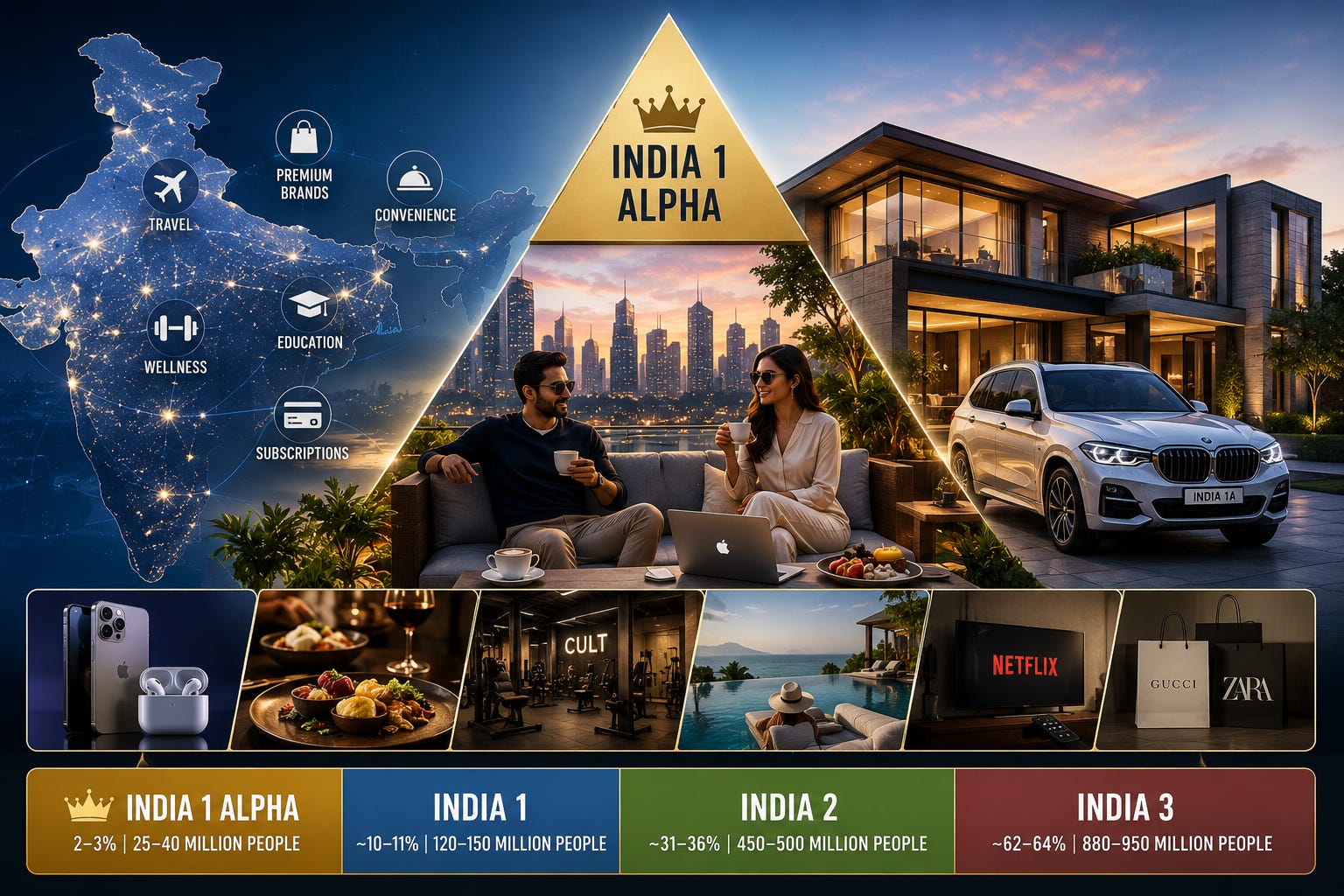
That section is what I call India 1 Alpha.
What is India 1 Alpha?
India 1 Alpha is not an official government category.
It is a market shorthand.
Think of it as the top slice inside India 1: the affluent, urban, English-fluent, convenience-seeking consumer class that routinely spends on premium products and services.
These are the people who can pay for:
Premium cars.
Branded goods.
Travel.
Good schools.
Subscriptions.
Convenience apps.
Premium fitness.
Good coffee.
Quality pet food.
Skincare.
iPhones.
MacBooks.
Boutique stays.
Domestic help.
Quick commerce.
Fine dining.
Wellness.
Coaching.
Consulting.
Experiences.
A practical estimate would be:
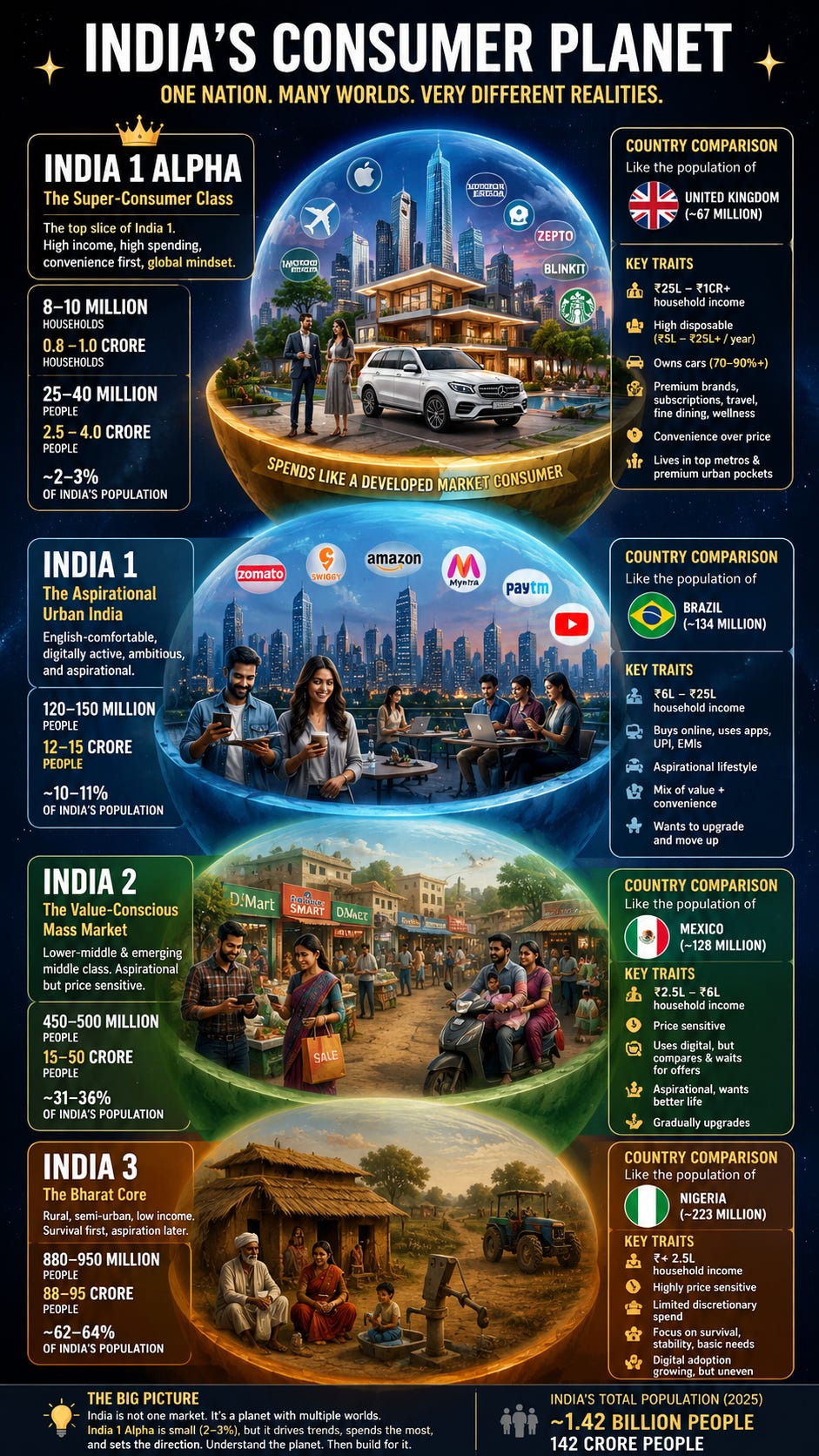
India 1 Alpha households: around 8–10 million households
India 1 Alpha people: around 25–40 million people
Share of India’s population: roughly 2–3%
That is tiny.
But in spending power, influence, and trend-setting ability, it behaves like a small developed country inside India.
These people are concentrated in places like Mumbai, Delhi NCR, Bengaluru, Pune, Hyderabad, Chennai, parts of Goa, and a few premium urban pockets across India.
They are not the average Indian consumer.
They are the consumer that most premium startups secretly design for first.
India is not one market
One of the biggest mistakes people make is talking about “India” as if it is one market.
It is not.
India is many countries living inside one country.
There is India 1.
There is India 2.
There is India 3.
And inside India 1, there is India 1 Alpha.
If you do not understand this, your business strategy will be confused.
You will create content for one group, price for another group, market to another group, and then wonder why nobody is buying.
India 1: The English-comfortable, urban, aspirational class
If you are reading this newsletter comfortably in English, there is a very high chance that you are already part of India 1.
You may not be rich yet.
You may not be India 1 Alpha.
You may not own a luxury car or live in a premium gated society.
But if you are English-comfortable, digitally active, paying online, learning through newsletters, watching YouTube for self-improvement, using UPI, ordering online, thinking about your career, business, investing, or personal brand, then you are most likely part of India 1.
India 1 is the urban, educated, digitally connected class.
They use apps.
They buy online.
They speak or understand English.
They consume content from global creators.
They have aspirations beyond survival.
They want upward mobility.
They care about careers, brands, skills, investing, lifestyle, health, travel, and status.
But India 1 is still broad.
A fresher earning ₹35,000 per month in Bengaluru is India 1.
A senior software engineer earning ₹60 lakh per year is also India 1.
A founder living in Indiranagar and ordering from Zomato every day is India 1.
A salaried professional in Chennai carefully managing EMIs and SIPs is also India 1.
That is why we need a sharper category.
That sharper category is India 1 Alpha.
India 1 Alpha: The super-consumer class
India 1 Alpha is the top of India 1.
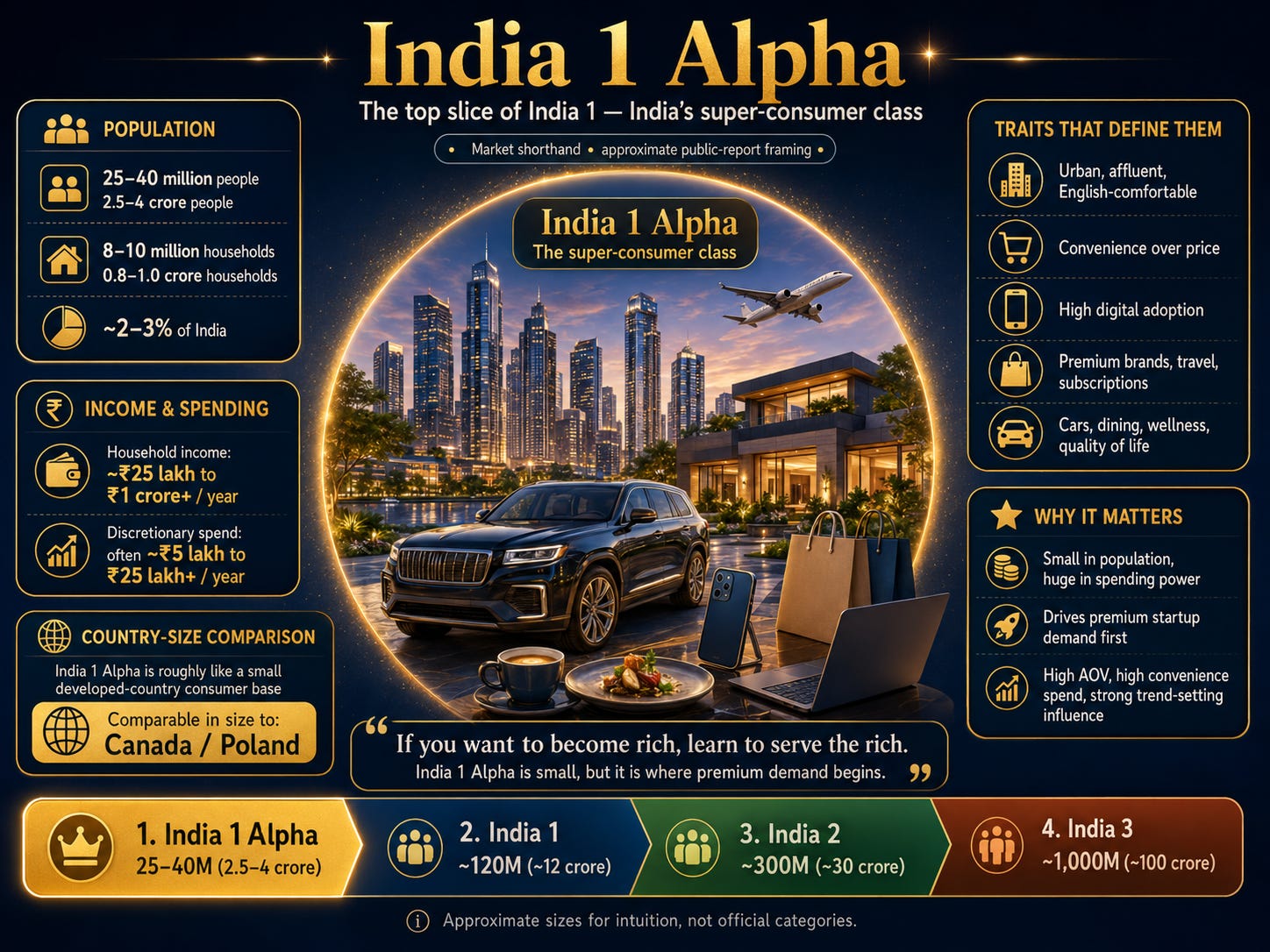
This is the class that does not merely consume. It over-consumes relative to the Indian average.
They are the people who say:
“I know it costs more, but it saves time.”
That one sentence explains a large part of modern Indian consumer startup culture.
It explains food delivery.
It explains Blinkit, Zepto, and Instamart.
It explains premium gyms.
It explains house help apps.
It explains D2C skincare.
It explains iPhones.
It explains cafes.
It explains cloud kitchens.
It explains pet food brands.
It explains wellness brands.
It explains premium schools.
It explains luxury SUVs.
India 1 Alpha values time compression.
They will pay more if it saves them time, effort, uncertainty, or social embarrassment.
They do not always want the cheapest option.
They want the convenient option.
The trusted option.
The premium option.
The branded option.
The faster option.
The better-looking option.
The status-enhancing option.
This is why the rich are such powerful customers.
They do not just buy utility.
They buy identity.
India 2: The value-conscious mass market
India 2 is much larger than India 1.
This is the lower-middle and emerging-middle consumer class.
They are aspirational, but much more price-sensitive.
They may use smartphones, UPI, WhatsApp, YouTube, and ecommerce, but their purchasing decisions are more careful. They compare prices. They wait for discounts. They think harder before subscribing. They may want premium things, but affordability matters a lot more.
India 2 is not poor.
But India 2 does not have the same discretionary spending power as India 1 Alpha.
For India 2, a ₹499 subscription may require thought.
For India 1 Alpha, it may be invisible.
For India 2, ordering food three times a week may feel indulgent.
For India 1 Alpha, it may feel normal.
For India 2, a ₹5,000 course may be a serious decision.
For India 1 Alpha, it may be an impulse buy if the perceived value is strong.
This distinction matters.
Because if you are selling premium products, consulting, coaching, services, experiences, personal branding, luxury, wellness, convenience, or transformation, India 2 may admire you but not always buy from you.
Admiration is not revenue.
India 3: The survival and informal economy
India 3 is the largest and most economically constrained part of India.
This is where affordability, access, and basic needs dominate.
People in India 3 are not thinking about premium convenience. They are thinking about survival, stability, cash flow, family obligations, and basic upward mobility.
This market is massive.
But serving India 3 profitably is extremely hard unless you have scale, distribution, operational excellence, government support, low-cost models, or deep patience.
You cannot casually build a premium online business for India 3.
You cannot sell them the same thing you sell to India 1 Alpha.
You cannot copy-paste a Bengaluru startup model and expect it to work in India 3.
The psychology is different.
The economics are different.
The trust barriers are different.
The price sensitivity is different.
The distribution challenge is different.
Why most founders get confused
Many entrepreneurs say they want to build for India.
But which India?
Are you building for the person who buys an iPhone every two years?
Or the person who saves for six months to buy a smartphone?
Are you building for the family that pays ₹3 lakh per year for school?
Or the family that struggles with basic education access?
Are you building for someone who orders groceries in 10 minutes?
Or someone who walks to the local shop because delivery charges feel wasteful?
Are you building for someone who sees ₹10,000 as dinner for two?
Or someone who sees ₹10,000 as half a month’s household budget?
These are not the same customers.
They may live in the same country.
They may use the same internet.
They may even follow the same influencers.
But they do not have the same purchasing power.
And business is not built on audience size alone.
Business is built on the ability and willingness to pay.
Serve the rich to become rich
This is where the lesson becomes personal.
Many people reading this newsletter are probably in India 1.
You are educated.
You are English-comfortable.
You are online.
You are ambitious.
You want to grow.
You want to build income.
You want to improve your life.
But you may not yet be India 1 Alpha.
You may still be careful with money.
You may still think twice before spending ₹20,000 on a course, ₹50,000 on a consultant, ₹1 lakh on a premium service, or ₹10 lakh on a major lifestyle upgrade.
That is fine.
But if you want to move from India 1 to India 1 Alpha, your customer cannot always be someone exactly like you.
You have to learn to serve people above your current economic level.
That is one of the fastest ways to rise.
If you are a freelancer, serve premium clients.
If you are a consultant, solve problems for businesses with money.
If you are a creator, attract an audience with high purchasing power.
If you are a coach, help people who can pay for transformation.
If you are building a product, build for a customer who already spends in that category.
If you are starting an agency, do not chase clients who negotiate every rupee. Chase clients who value outcomes.
This is not arrogance.
This is strategy.
The rich pay for outcomes
Poor customers usually pay for effort.
Middle-class customers often pay for affordability.
Rich customers pay for outcomes.
They do not want the cheapest designer.
They want the designer who understands taste.
They do not want the cheapest consultant.
They want the consultant who saves them time and prevents expensive mistakes.
They do not want the cheapest fitness coach.
They want the coach who gives them accountability, privacy, personalization, and visible results.
They do not want the cheapest pet food.
They want something safe, trustworthy, premium, and emotionally satisfying.
They do not want the cheapest school.
They want the school that gives their child status, exposure, network, and confidence.
They do not want the cheapest travel plan.
They want a smooth experience.
When you sell to the rich, you are not merely selling the product.
You are selling certainty.
You are selling time.
You are selling taste.
You are selling status.
You are selling convenience.
You are selling peace of mind.
You are selling transformation.
That is why margins are higher.
Premium markets are smaller, but better
A common mistake is to chase the largest audience.
People think:
“India has 1.4 billion people. Even if I get 1%, I will be rich.”
This is lazy market thinking.
You will not get 1% of India.
You may not even get 0.01%.
Instead of chasing theoretical TAM, ask:
Who has the money?
Who has the pain?
Who already spends?
Who values speed?
Who values quality?
Who values status?
Who will pay for the best solution?
A smaller market with higher purchasing power is often better than a huge market with no ability to pay.
This is why so many Indian startups first succeed in places like Indiranagar, Koramangala, Bandra, Powai, Gurgaon, South Delhi, Kalyani Nagar, Jubilee Hills, and premium parts of Mumbai, Delhi NCR, Bengaluru, Pune, and Hyderabad.
They do not start with “India.”
They start with rich India.
They get what I call Indiranagar Market Fit before they try to get India Market Fit.
India 1 Alpha sets the trend
India 1 Alpha is small, but it is culturally powerful.
What India 1 Alpha consumes today, India 1 may aspire to tomorrow.
What India 1 aspires to tomorrow, India 2 may slowly adopt later in a cheaper form.
This is how many categories evolve.
First, something is premium.
Then it becomes aspirational.
Then it becomes mass.
Cafes were once premium.
Smartphones were once premium.
Food delivery was once premium.
Online courses were once unusual.
Fitness culture was once niche.
Pet parenting was once urban elite behavior.
Premium skincare was once limited.
India 1 Alpha tries things early.
They absorb the high prices.
They validate the category.
They create the social proof.
Then the market expands.
This is why serving India 1 Alpha is not just about making money today.
It is also about understanding where India is going tomorrow.
But do not confuse India 1 Alpha with India
There is one major caution.
India 1 Alpha is not India.
It is a small premium bubble.
If your product works in South Delhi, Bandra, or Indiranagar, it does not automatically mean it will work across India.
If people in your circle casually spend ₹500 on coffee, that does not mean India is ready for ₹500 coffee.
If your friends use iPhones, that does not mean India is an iPhone market.
If your network pays for therapy, premium gyms, subscriptions, and boutique travel, that does not mean the average Indian household has that spending power.
Founders often make this mistake.
They look at their own social circle and think they understand India.
They do not.
They understand India 1 Alpha.
That is valuable.
But it is not the whole country.
The opportunity for you
The opportunity is not to resent India 1 Alpha.
The opportunity is to understand them.
Study how they think.
What do they buy?
What do they fear?
What do they desire?
What problems do they outsource?
What signals status in their world?
What inconveniences irritate them?
What do they want done for them?
What do they not have time to learn?
What are they willing to pay a premium for?
Rich people have problems.
But their problems are different.
They worry about time.
They worry about reputation.
They worry about health.
They worry about their children.
They worry about quality.
They worry about convenience.
They worry about trust.
They worry about taste.
They worry about performance.
They worry about access.
If you can solve these problems, you can charge more.
And if you can charge more, you can build wealth faster.
You do not become rich by thinking cheap
This is another uncomfortable truth.
If your mind is always focused on discounts, cheap customers, low-ticket offers, and mass affordability, it becomes difficult to build a premium business.
To serve premium customers, you must upgrade your own thinking.
You must understand quality.
You must understand positioning.
You must understand trust.
You must understand packaging.
You must understand language.
You must understand taste.
You must understand aspiration.
You must understand why someone will pay ₹1 lakh for something that another person thinks should cost ₹5,000.
The difference is not always stupidity.
Often, the difference is value perception.
A rich person is not paying for the same thing.
They are paying for a better experience, lower risk, higher trust, faster result, and stronger identity.
The final lesson
If you are reading this in English, you are probably already in India 1.
That itself is a privilege.
You are not at the bottom of the pyramid.
You have access to knowledge, language, internet, digital payments, networks, and opportunities that most people in India still do not fully have.
But if you want to become India 1 Alpha, you must stop building only for people at your current level.
You must learn to serve people with more money than you.
Not to flatter them.
Not to worship them.
Not to become fake.
But to understand value creation at a higher level.
Because the fastest way to upgrade your income is to upgrade the customer you serve.
Serve people who can pay.
Solve problems worth paying for.
Build trust with premium customers.
Package your work with taste.
Create outcomes, not just effort.
Charge for value, not time.
India 1 Alpha may be only 2–3% of the country.
But for entrepreneurs, creators, coaches, consultants, freelancers, agencies, and premium brands, it may be the most important 2–3%.
The average Indian market gives you scale.
But the rich Indian market gives you margin.
And if you want to get rich, margin matters.
So here is the uncomfortable but useful truth:
If you want to become rich, learn to serve the rich.