

In 2014, I attended a workshop by Gerry Robert called Publish a Book and Grow Rich. I came home and wrote a 4,500-word guide to publishing a book on your own. I typed every word myself, because back then nothing could write it for you. That post has ranked on Google for twelve years, right below the Amazon listing for Gerry’s own book.
Then I took four more years to publish my first book.
You don’t need to wait that long. Since then I’ve published a few books, most recently Deep Marketing (288 pages, more than 100 illustrations), and I’m deep into the next one, Deep Offers. I recently walked my community through my entire process on a live call.
Why write a book at all?
The why matters more than the how, so let’s start there.
Your learnings finally live in one place
Think of every meeting, webinar and conference where you took notes. Where are those notes now? In a black hole. A notebook that vanished when you shifted houses. A phone note you never reopened. The reels you saved and the videos parked in Watch Later. Most of us will leave this world with 2,000 saved reels we never watched.
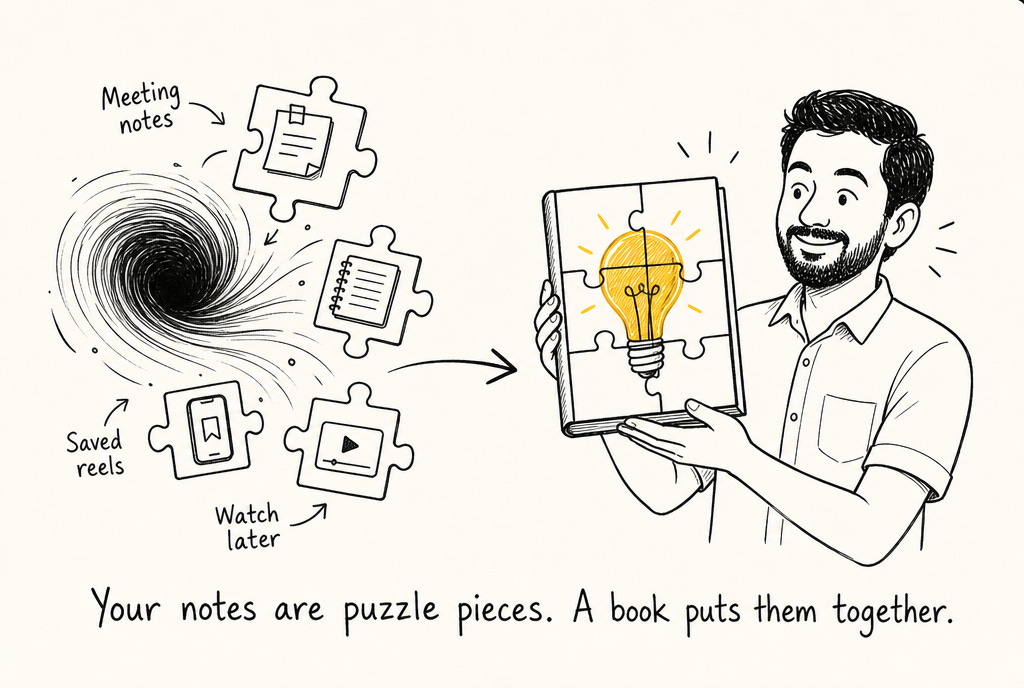
A book forces you to organise all of it. You may or may not read other people’s books, but you will read your own, many times. That makes writing one of the best ways to learn.
It’s why I started digitaldeepak.com: to remember what I was learning. Writing forces you to think. Your knowledge is a pile of puzzle pieces, and there’s no picture until you put them together. When I wrote Deep Marketing, the CATT framework (Content, Attention, Trust, Transaction) became clearer to me than to anyone else. I was the first reader of my own book, and it still helps me apply CATT in my own business.
“Author” comes from “authority”
A book proves two things: that you know something, and that you can finish a large project, which takes dedication, commitment and discipline.
When big American banks and companies hire in India, they go to the IITs, the IIMs and BITS Pilani. Not because those campuses teach something that makes people better at the job. It’s a filter. Anyone disciplined enough to clear those entrance exams has already proven their focus.
A book is that filter for experts. Maybe you rated my expertise 3 out of 10 before my book reached you. With it in your hands, it’s closer to 7. We already think of people who read books as intellectuals. Imagine how we see people who write them.
Your competition is lazier than you think
For six or seven years, I’ve told everyone to build an email list. How many coaches, even successful ones, have actually done it? Hardly any.
Never underestimate the power of people’s laziness. How many people do you know who can watch a two-hour movie without checking reels or WhatsApp? Even the discipline to sit and work with Claude for a few hours is rare. AI tools have been around for a few years, and most experts still aren’t authors. Write a book and you’re ahead of 99.9% of people. Before the Terminator days arrive, whether that’s three years away or ten, use the intelligence available to you right now.
A book makes you the obvious choice
If you’re choosing between me and a competitor, and I have a book and they don’t, who looks like the bigger authority? In coaching, consulting and any expert business, that matters enormously.
Imagine Colgate’s CEO wrote a book on dental health. You’d probably start seeing Colgate as better than Pepsodent without reading a page. The book’s existence does the work.
When Ashish, who heads operations for us, announced he was writing a book on AI, all we did was make a 3D mockup of the cover with an AI tool. At our Chennai book launch event, people were lining up for selfies with him.
A book is indoor marketing
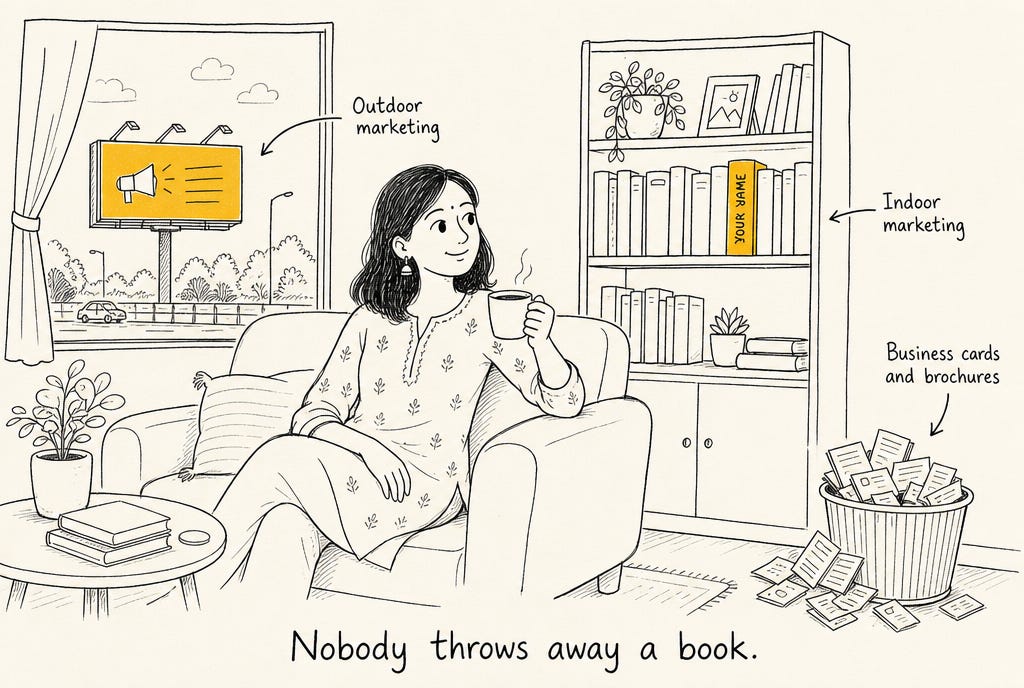
Hoardings and banners are outdoor advertising. A book is indoor advertising. Phone and laptop screens are small, but your room, your desk and your shelf are a lot of ad space. If you have a copy of Deep Marketing, you probably see it, and my name, a few times a week. That’s remarketing inside your home. People used to take selfies with me at events. Now they take selfies holding the book.
And nobody throws away a book. Business cards and brochures end up in the dustbin, and emails get deleted. A book collects dust in a cupboard or gets passed on. In India this runs deeper. If your foot ever brushed a book, you touched the book and then your eyes or forehead, right? We’re raised to treat books like Saraswati herself. So the close to 2,000 copies I’ve sent out are 2,000 objects with my name on them, sitting in homes and offices for years.
A small confession. At a Bangalore airport bookstore, I was browsing with a few books in hand, one of them mine. When I put some back on the shelf, Deep Marketing “accidentally” went back too. It won’t show up in their stock system, and I doubt anyone will have the heart to throw out a book. Free advertising. Next time I fly, I’m checking whether it’s still there.
The cheapest lead magnet and follow-up you’ll find
Many coaches spend ₹1,500 to ₹2,000 in ads to get one person to pay ₹99 for a workshop. I can run ads, collect addresses and ship a physical book for ₹300 to ₹400 all in. Tuck a sales letter or brochure inside, with a QR code leading to a landing page or video sales letter, and the book starts selling for you.
It’s also a great follow-up. If a high-ticket sales call doesn’t convert, send the prospect your book. They may only skim it, but they’re engaging with you. I compared prices with the usual corporate gifts like pens, keychains and t-shirts, and a book isn’t more expensive. When I print 1,000 copies in bulk on an offset press, the cost drops to about ₹110 a book.
The tax angle
Printed books in India are exempt from GST, while courses and services typically attract 18%. Ebooks get a lower 5% rate only when the same book also exists in print, so an ebook-only title doesn’t qualify. Rules change, so check with your CA before you price anything.
Try this before you read any further
Here’s the exercise I gave everyone on the call. Come up with a title for your book, open ChatGPT and type something like:
I’m writing a book called [title] by [your name]. Create a 3D book cover illustration for it.
Share the image with a friend or your WhatsApp group and notice how it feels. You may never have pictured yourself as an author. This makes it real. Put your name on the cover, not just the title.
Within two minutes, people were sharing covers: a relationship book about loving without losing yourself, a guide to turning ideas into systems, a book on financial planning. Now commit: your book will be published within the next three to six months.
“But why would anyone read my book?”
Someone asked this on the call. If you’re still learning, and people can find the same information elsewhere, why read yours?
Because people are lazy. Nobody is going to read six books on building offers. They’ll read Deep Offers, because it distils those six books and teaches the ideas my way: illustrations, simple chapters, a clear roadmap and very easy language. That combination is a format, and formats sell.
Look at For Dummies. Since DOS For Dummies came out more than 30 years ago, the series has published over 2,000 titles, sold around 250 million copies and generated about $2 billion in retail sales. That’s roughly eight million copies a year. Those topics were already covered elsewhere. Dummies wins on format: big pages, easy reading, illustrations, tips and bullet points, written with experts in each field. A dog food expert could end up writing Dog Nutrition For Dummies. One longtime Dummies author has said the real test isn’t knowledge but explaining complex material in plain, friendly language.
The same goes for you. People who connect with the way you explain things would rather learn from you. Publishing doesn’t cost much anymore, so publish and see what happens. At worst, you’ll have a book in your hands.
Step 1: Start with a beta book
The hardest part of a first book is integration. Every concept has to fit with every other one, in one consistent voice, so the book reads as a single tight unit. Holding a whole book in your head takes experience. Part of J.K. Rowling’s genius is that she kept seven interlocking Harry Potter books in her mind. Even with AI, I still wrestle with reordering chapters and keeping the full context fresh.
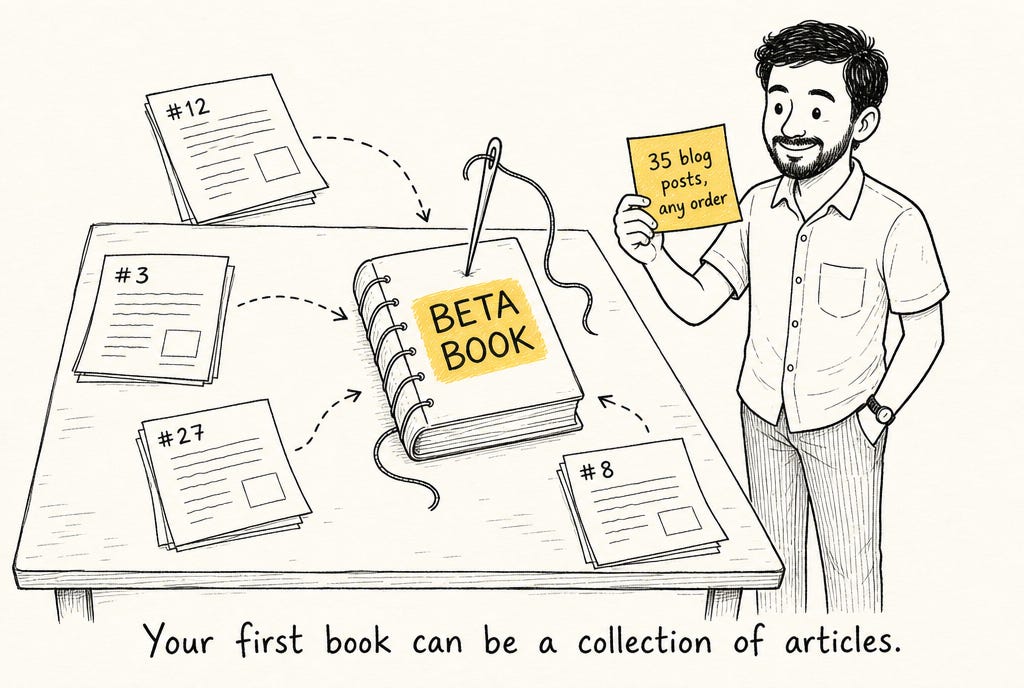
So for your first book, skip that problem. Publish a beta book: a collection of articles, in no particular order. Writing in order is what makes a first book feel overwhelming.
That’s what I did in 2018 with Edge of Sanity, which was 35 of my blog posts. A collection of articles is still a book, and it gets you over the line.
It can be about anything: your life lessons, which nobody else has; your experiences in business, life, health or relationships, like a challenge you went through and what helped you come out of it; or your learnings from other sources, which is really your notes, finally organised.
The output of this step is a manuscript: a Google Doc with all your text in it.
Step 2: Write the manuscript with AI as your ghostwriter
Write the first draft yourself
Start on your own. Forget how it sounds and write the way you’d write an email to a friend. A structure will appear, and so will momentum. Then bring in AI.
I wrote 30,000 words of Deep Marketing back in 2022. At that depth, the finished book would have become an 800-page, 200,000-word monster, and I wanted a 40,000 to 50,000-word business book with illustrations. So I gave the draft to AI and asked it to read the whole thing and create a chapter outline. That outline became the backbone.
Let AI read the books you don’t have time for
Much of the thinking in Deep Offers comes from six books, and I didn’t read all six. I uploaded them to Claude along with Deep Marketing and asked for the key ideas my readers would benefit from. It produced a 10,000-word document. The books often contradict each other, so Claude also helped decide which concepts fit my audience. Monetizing Innovation by Madhavan Ramanujam and Georg Tacke, for example, is about why new products fail and is written for product companies, but several of its ideas apply beautifully to consulting.
YouTube works too. Find summaries of books you care about, pull the full transcript with any free YouTube transcript tool (paste the link, get the text), and load it into Claude or ChatGPT.
One rule: attribute everything. In Deep Marketing, and even more in Deep Offers, I tell readers where each idea came from. Done this way, writing your own book is one of the best ways to read a lot of books.
Out of ideas? That’s normal
One member told me he’d put every idea he had into four or five chapters. Get more from Claude. You don’t need brand-new ideas. You can take what others have said and apply it to your audience’s context. Deep Offers takes ideas from consulting firms and applies them to the Indian market, and takes ideas from product design and applies them to consulting.
Teach AI to sound like you
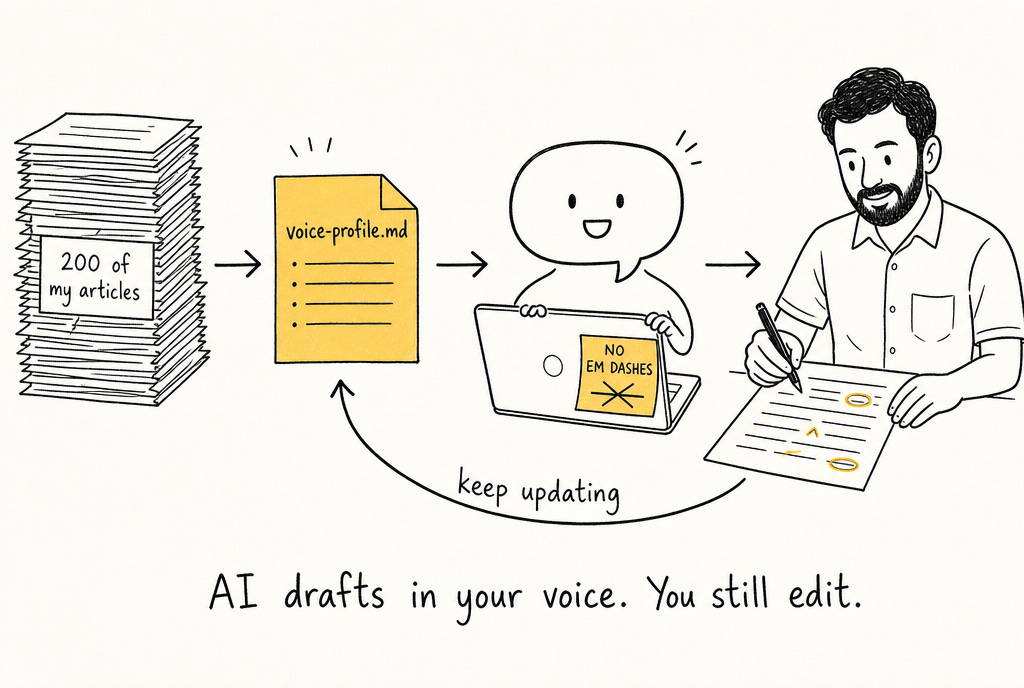
I’ve given Claude around 200 of my articles to learn my voice. You don’t need Projects or anything fancy. In a regular Claude chat, build a voice profile and keep updating it as one Markdown (.md) file. Then, every time you ask for writing, add: “Refer to my voice profile and write in my style.”
Keep expectations realistic. Even on the top model and the highest plan, it never fully sounded like me. I still read everything, rewrote parts by hand and ran a final grammar check.
Put this line in your profile: don’t use em dashes. Those long dashes are all over AI writing, and real people rarely use so many. I don’t even know how to type one on my keyboard.
Learn each tool’s personality, too. When I started, ChatGPT wrote in very simple English, didn’t go deep, and used lots of line breaks. Claude built a more complete structure but could make the wording cryptic. An earlier draft of the Deep Offers introduction had a section called “What This Book Will Cost You.” Clever, but I had to read it twice. A newer Claude model renamed it “What You Will Need to Change.” Same idea, no decoding.
Talk instead of typing
When a chapter is done and I want to add a few thoughts but don’t know where they fit, I record a five-minute voice note into ChatGPT or Claude and say, “Integrate these thoughts into the chapter.” My experience, my thoughts, my examples. The AI works as my editor and proofreader.
Know what AI can’t do
Plenty of famous books were ghostwritten. Donald Trump’s The Art of the Deal was written by Tony Schwartz, who later spoke about it publicly. Today you get a very intelligent ghostwriter, with real limitations, for as little as $20 a month.
But you can’t type “ChatGPT, write me a book,” send the result to a publisher and call it done. Itna aasan nahi hai. It isn’t that easy. Even with every AI tool, it’s a lot of work, and it takes longer than you think.
How long should it be?
Keep it to 50,000 words or fewer. Beyond that, the book gets heavy.
A page holds roughly 200 to 250 words, depending on font size and page dimensions. With illustrations, mine came to about 150. Deep Marketing is 45,000 words and 288 pages. Spiritual Money, with no illustrations, was about 35,000 words and 188 pages. At 150 words a page, 60,000 words becomes a 400-page book, with higher printing costs, higher shipping costs and more weight.
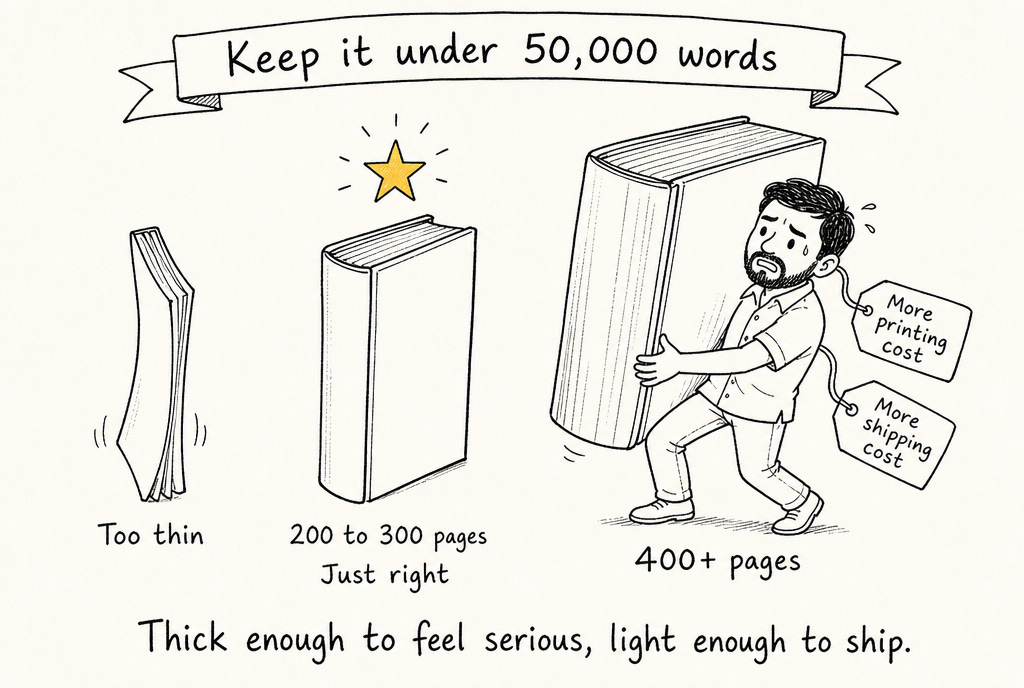
Aim for 200 to 300 pages: thick enough to feel serious, thin enough to keep costs sensible. I’m taking my own advice. One draft of Deep Offers grew to about 64,000 words, and I’m cutting it back to around 45,000.
Step 3: Illustrations, only after the manuscript is done
Illustrations can transform a book, but the process is long and it gets expensive. So, rule one: finish the manuscript before you touch a single illustration. I illustrated Deep Offers around its sixth or seventh draft. Then the whole book got rewritten, and now I’m recreating every image.
To keep it simple, add a few AI-generated images that explain key concepts, or sketch something yourself and ask ChatGPT to turn it into a clean illustration. If you want to go further, here’s how I did Deep Marketing‘s 100-plus illustrations.
Let Claude think and ChatGPT draw. In my experience, Claude comes up with better illustration ideas, but it can’t draw, and ChatGPT can. So I paste a chapter into Claude and ask for three to five types of illustration, with ready-to-use prompts for ChatGPT. Sometimes I start from my own doodles: Claude reads the chapter, sharpens the idea and writes the brief.
Tell Claude the text will render. Claude tends to assume image models can’t render text and tells you to add the words later in Canva. My response: “Bhai, tu mujhe kaam mat de. Main tujhe kaam de raha hoon.” Don’t give me work, I’m giving you work. Tell it to assume the text will render and to write the complete prompt.
Lock the style first. I wanted minimalist, doodle-like art without heavy outlines (but not stick figures like Alex Hormozi’s books), with the same caption font at the bottom of every image. Get two or three images exactly right. After that, ask Claude for ten prompts per chapter and keep the best three, since only some concepts work visually. “The loud expert gets more customers” became a man shouting into a megaphone with a crowd around him while the quieter expert stands alone. Claude came up with it. ChatGPT drew it.
Keep your characters consistent. Deep Marketing has three recurring characters with internal code names: Arjun is the expert, Bunty is the competitor and Mira is the target customer. The names never appear in the book. They exist so the faces stay identical across every image. Each time I generate a new one, I attach a few earlier images as references, and I told Claude to mention those attachments in every prompt it writes. It took seven or eight rounds before the consistency clicked.
Get the resolution right. Books print at 300 DPI, so the pixels you need are roughly the printed width in inches times 300. ChatGPT’s standard output is around 1,500 × 1,000 pixels, which barely stretches to a 5-inch print, and I realised those images would pixelate in the book. So I moved to Higgsfield, which connects to several image models. With the ChatGPT model selected, you can generate at 1K, 2K or 4K. I use 3:2 for horizontal images and 2:3 for vertical ones, and it generates eight images at a time. For Deep Marketing I uploaded each image and asked for a 4K version, but 2K is plenty for a 6 x 9 book and keeps the files lighter. Fair warning: it’s addictive, and I’ve burned an enormous number of credits. Completely worth it.
Once your style is locked, it goes further. I made the chapter page openers the same way, I can ask for a softly coloured version of any image, and I even built a custom illustrated book for one of my Alpha Club members as an experiment.
Can you outsource all this? You already are, to Claude, ChatGPT and Higgsfield. What you can’t hand over is control, because you’re the one who knows what each chapter needs.
Step 4: Typesetting
Typesetting decides how your book looks page by page. Hire a typesetter on Upwork, Fiverr or Freelancer, ideally someone skilled in Adobe InDesign, still the market leader for book interiors. I gave a two-chapter sample to ten typesetters and picked one in the Philippines through Upwork. He’ll typeset Deep Offers and my future books too.
Here’s what you and your typesetter need to get right.
Recto and verso. The right-hand page of an open book is the recto, the left-hand page is the verso. Recto is right.
Gutter margin. The inner margin near the spine needs extra room, because binding swallows part of the page. So a verso gets a wider right margin and a recto gets a wider left margin, but not so wide that the page looks empty. A good typesetter knows the standards.
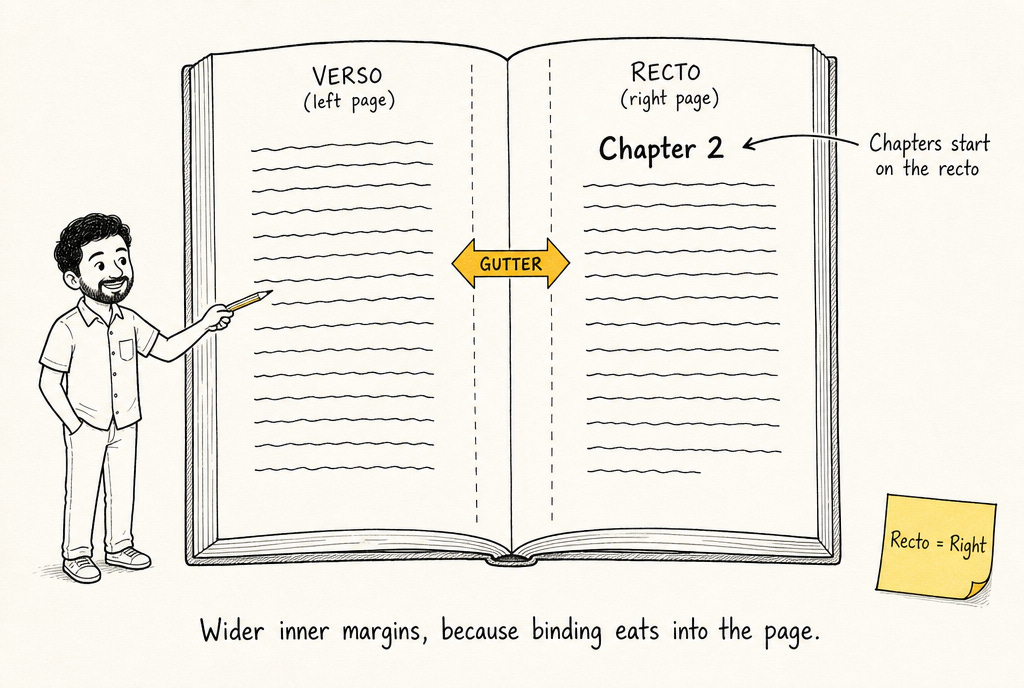
Chapters start on a recto. Check any book. In Deep Marketing, each chapter opens with an illustrated page on the left, and the chapter itself begins on the right. If the previous chapter ends on a right page, everything flows. If it ends on a left page, the next right page would be blank. My fix: I wrote a closing quote for every chapter and told my typesetter to use it only when a blank page needs filling. That’s why some chapters end with a quote and others don’t.
Image placement. Images can’t go just anywhere. Text has to wrap around them, or you get awkward gaps.
Font size, leading and kerning. Leading (pronounced “ledding,” after the strips of lead old typesetters placed between lines) is line spacing, and every font size has a recommended leading. Big type with cramped lines looks bad. My typesetter set Deep Marketing at 12-point type on 16-point leading. Kerning is adjusting the space between specific pairs of letters.
Trim size. Decide the dimensions during typesetting. I chose 6 x 9 inches, a solid standard for business books, and 5 x 8 is also common. 9 x 9 is closer to a coffee table book: fully illustrated, art paper, hardbound. I’m considering a premium 9 x 9 illustrated edition or workbook of Deep Marketing, bundled with the course and with its own ISBN. Alex Hormozi’s $100M books use a large format close to A4. Ask ChatGPT for the standard sizes, then ask your publisher which ones they print, since their presses only handle certain sizes.
All of this took far more time, money and decisions than I expected. The result is your final typeset file, ready for a publisher.
Step 5: The cover
Develop cover concepts with AI, then have a designer produce the final front cover, back cover and spine to your publisher’s specifications.
Spine width depends on page count and paper thickness, so give your designer an estimate early. The spine carries your title and name vertically, and the publisher can adjust it slightly once the final thickness is known.
For Deep Marketing, I ran a $500 design contest on 99designs. I don’t recommend that for beginners; it’s steep. But I’d put so much into this book, and I was spending lakhs of rupees to send out 2,000 copies, so the extra 10% of refinement over a local designer was worth it.
Don’t benchmark your budget against mine. I’ve been doing this for 15 years, and I spend more on design and typesetting than most people need to. You can get a decent cover on Fiverr for around ₹1,000. Start there.
Step 6: Publish with a self-publisher
HarperCollins, Penguin, McGraw Hill: traditional publishing exists, but it’s restrictive and slow. You want a self-publisher.
Notion Press bundles nearly everything: cover design, ISBN, typesetting and print on demand. Their plans start at around ₹30,000. When I published with them, my frustration was the correction cycle. I’d send a fix today, their typesetter would respond tomorrow, and the delays piled up.
Clever Fox Publishing has a Quick Publish option starting at ₹2,500. You get an ISBN, registered to them as publisher, and a final author proof: a PDF showing exactly how your book will look. For about ₹4,000 more, they list it on Amazon and Flipkart. That’s the setup behind Deep Marketing: my own typesetter, my own cover designer and Clever Fox as publisher.
Print on demand. You can’t print thousands of copies, stock Amazon’s warehouses and ship orders yourself. Self-publishers work on print on demand (POD): books are printed as orders come in, with some stock kept and refilled in warehouses. Deep Marketing‘s Amazon listing shows Repro Books on Demand, Clever Fox’s printing partner. I’m not a publisher. I use one, and that’s fine.
Paper weight. GSM (grams per square metre) measures paper weight. Avoid 75 GSM; it can feel thin, and ink from the back of the page can show through. Use at least 80 GSM. Confession: my bulk run of 1,000 copies was 75 GSM, because costs were climbing. The print-on-demand copies Amazon ships are 80 GSM. You’d only notice side by side, where the 80 GSM copy feels a touch more premium.
ISBN. The International Standard Book Number is what turns a document into a book. For a Kindle-only ebook, you can publish directly through Kindle Direct Publishing (KDP), and KDP doesn’t require an ISBN for ebooks since Amazon assigns its own ASIN, though paperbacks and hardcovers do need one. Remember the GST point, though: the lower ebook rate depends on a print edition existing.
Step 7: Put the book to work
The book is where your marketing starts. My 30-day Deep Marketing email course grew out of the book. I used Claude to plan the 30 days of topics, reused the book’s illustrations, and wrote every lesson to promote the book. The book builds the list and the list sells the book, so don’t stress about which comes first. Then use it everywhere: mail it to your list, offer it in ads in exchange for a shipping address, tuck a QR code inside, and send it to prospects who didn’t convert.
The real secret: write it in one streak
In Deep Work, Cal Newport describes the grand gesture: a big, unusual commitment that raises the stakes on the work. J.K. Rowling, struggling to finish the final Harry Potter book at home, checked into a suite at the Balmoral, a five-star hotel in Edinburgh, and finished it there.
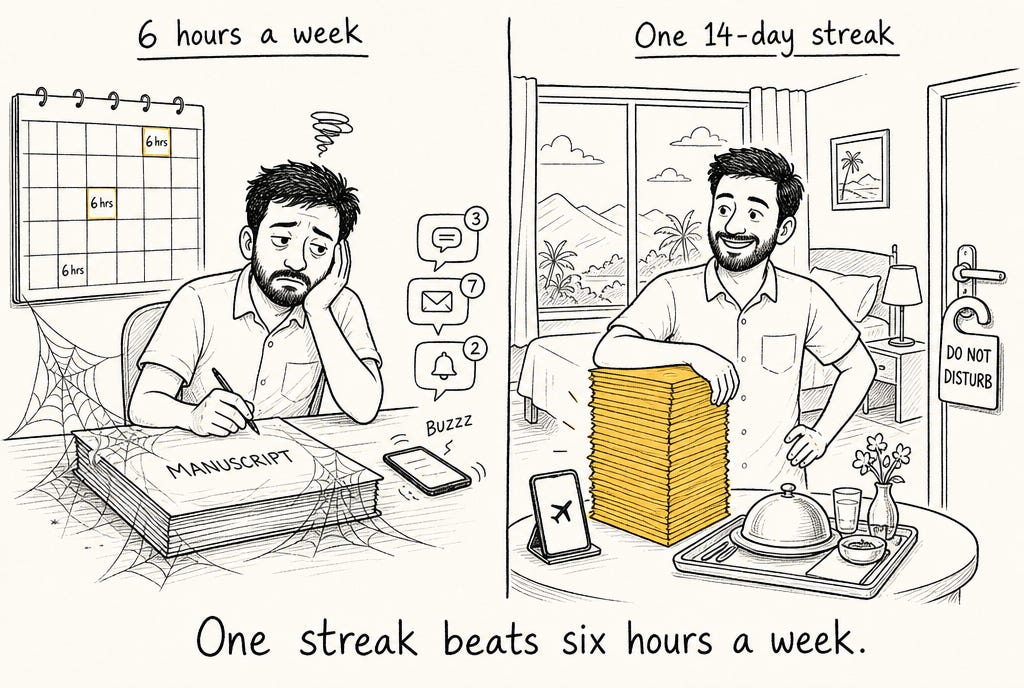
Do your own version. Block out 7 or 14 days and lock yourself in a hotel, ideally a five-star one, because when you’re paying that much, you feel the pressure to work instead of chill. Room service looks after you and nobody disturbs you. Put your phone on flight mode. Come out only when you’ve finished the book or run out of money.
Here’s why it matters. There’s enormous resistance in sitting down to reread one chapter and write the next. When my streak breaks, I lose a whole week, the project goes stale, and I start forgetting what it was about.
When I ran that session, I was on a workation writing Deep Offers, with the structure of every chapter fresh in my head. When your context is that fresh, protect it. No new inputs. No side projects.
It also helps not to be running heavy operations while you create. I told Ashish that I want to write books, publish courses and run offline events, and that operations needs someone who owns it full time. My job is to attract and nurture leads. Hiring, managing, team meetings and client calls on top of writing a book? Impractical, close to impossible.
If that’s your life right now, take two weeks off and write in one streak. It’s far easier than promising yourself six hours a week. Nahi hoga. Believe me, that won’t happen.
A book isn’t like the gym. You can’t work out daily for 30 days and then rest for a year, but you can write a book in one streak and be done. Life will pile up while you’re away: bills, credit card dues, an EMI, the plumber, the car service, a promise you made to someone. Ignore all of it until the book is done. It’s the only method I’ve found that works.
Pick your date
It’s September. Can you publish before the year ends? On the call, one member committed to December 31 and another to December 1. One told me he’s already 40,000 words in and getting clearer every day.
Here’s the whole process in one place:
Make a 3D cover mockup with your title and name, and commit to a date.
Write a beta book: a collection of articles on your lessons, experiences or notes, in any order.
Draft it yourself, then use AI to outline, research, match your voice and polish. Stay under 50,000 words.
Add illustrations only once the manuscript is final.
Test a few InDesign typesetters with a sample chapter and pick one.
Develop cover concepts with AI and have a designer finish the front, back and spine.
Publish through a self-publisher with an ISBN and print on demand, on at least 80 GSM paper.
Turn the book into an email course, a lead magnet and a sales follow-up.
Protect a 7 to 14-day writing streak.
Make the cover today. Pick your date. Then book the hotel.
Hit reply and tell me your book’s title and the date you’ll publish it.
How did you finish this within an hour of logging off from yesterday's Zoom meeting?
Deepak, thank you very much for covering the process so much in depth on the call and distilling key learning for us. Most importantly thank you very much for getting us initiated in writing a book.