In my last post I showed you how to publish a book in 2026. The beta book, the AI workflow, typesetting, the self-publisher, the two week writing streak. That post ends the moment your cartons arrive.
This post is about what happens next. Because the book is not the finish line. It is the asset you now have to put to work.
I recently listened to Chandler Bolt, who runs SelfPublishing.com, being interviewed by Cole Gordon. His company helps business owners write and publish books that grow their business. He says it has done $80 million in lifetime revenue and runs at roughly $10 million a year. He also says one of his own books generated $7 million in sales in the last twelve months, five years after he published it. That is close to ₹60 crore from a book that was already old.
Every figure in this post is his own claim from that interview, not an audited number. Treat them as claims. What interests me is not the size of the number. It is the machine underneath it, because most of that machine is available to a coach or consultant in India for a few thousand rupees.
Here is the part that made me sit up: he built it without ads and without a personal brand. In our industry, that combination barely exists. Everyone I know scaled with paid traffic or with content. He did neither for most of the journey. Today they do spend on ads, but the eight figure business was built before that.
What he actually sells
First, get the model straight, because this is where most people misread book businesses.
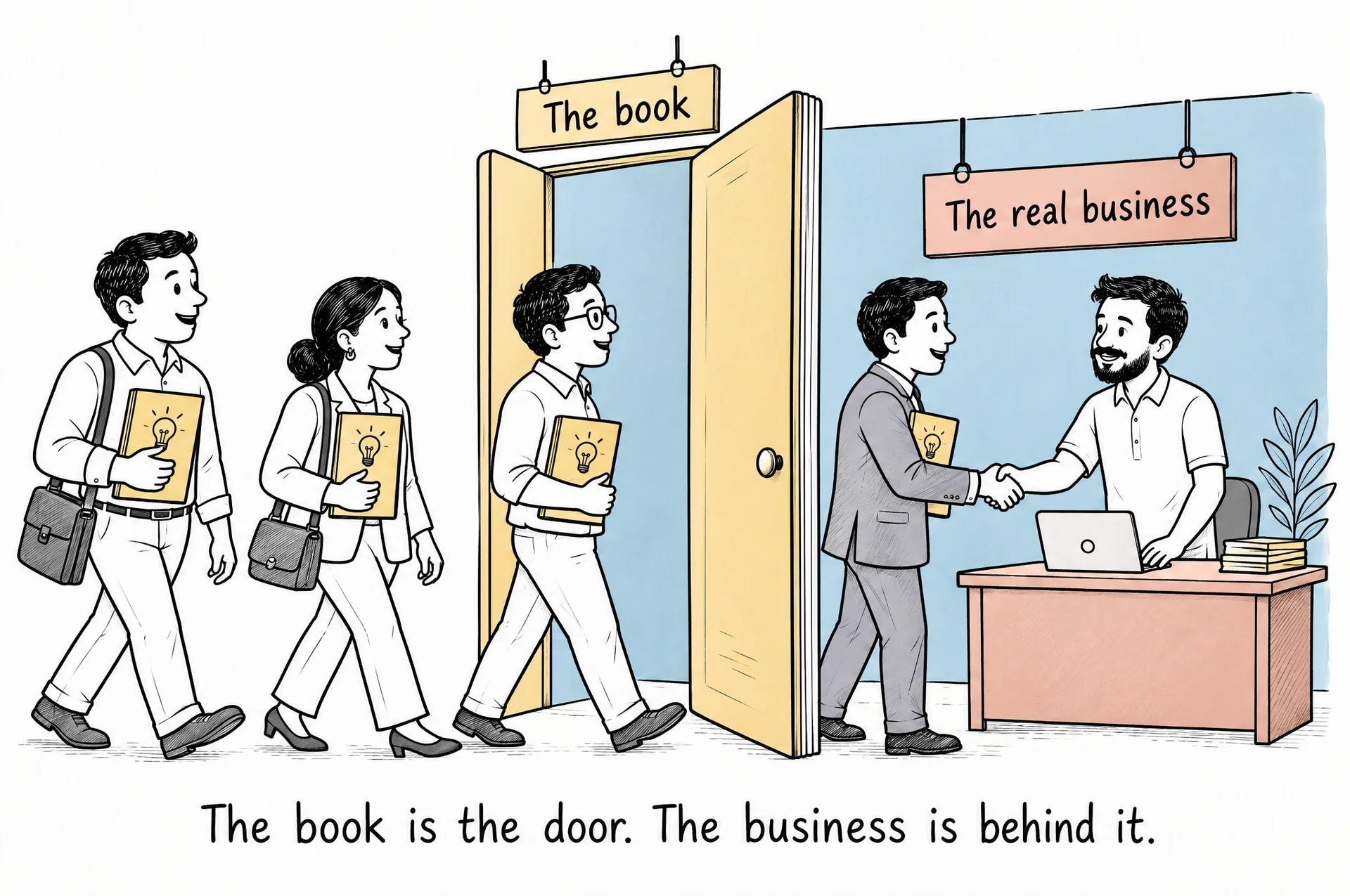
He does not make his money selling books. His customers pay between $8,000 and $100,000 to get their own book written and published, with most sitting in the $10,000 to $25,000 range. The book is the doorway. The service behind the door is the business.
This is exactly what I have been telling you. A book is not a product line. It is the front of a ladder. Deep Marketing is not where I make my money. It is where the relationship starts, and for me the far end of that path is Alpha Club.
So when you read the numbers below, read them as the cost of acquiring customers who pay lakhs, not as book royalties.
Partnerships are not networking. They are a sales department.
His biggest channel is partnerships. This year that channel alone should do $6 to $7 million, and he is barely involved.
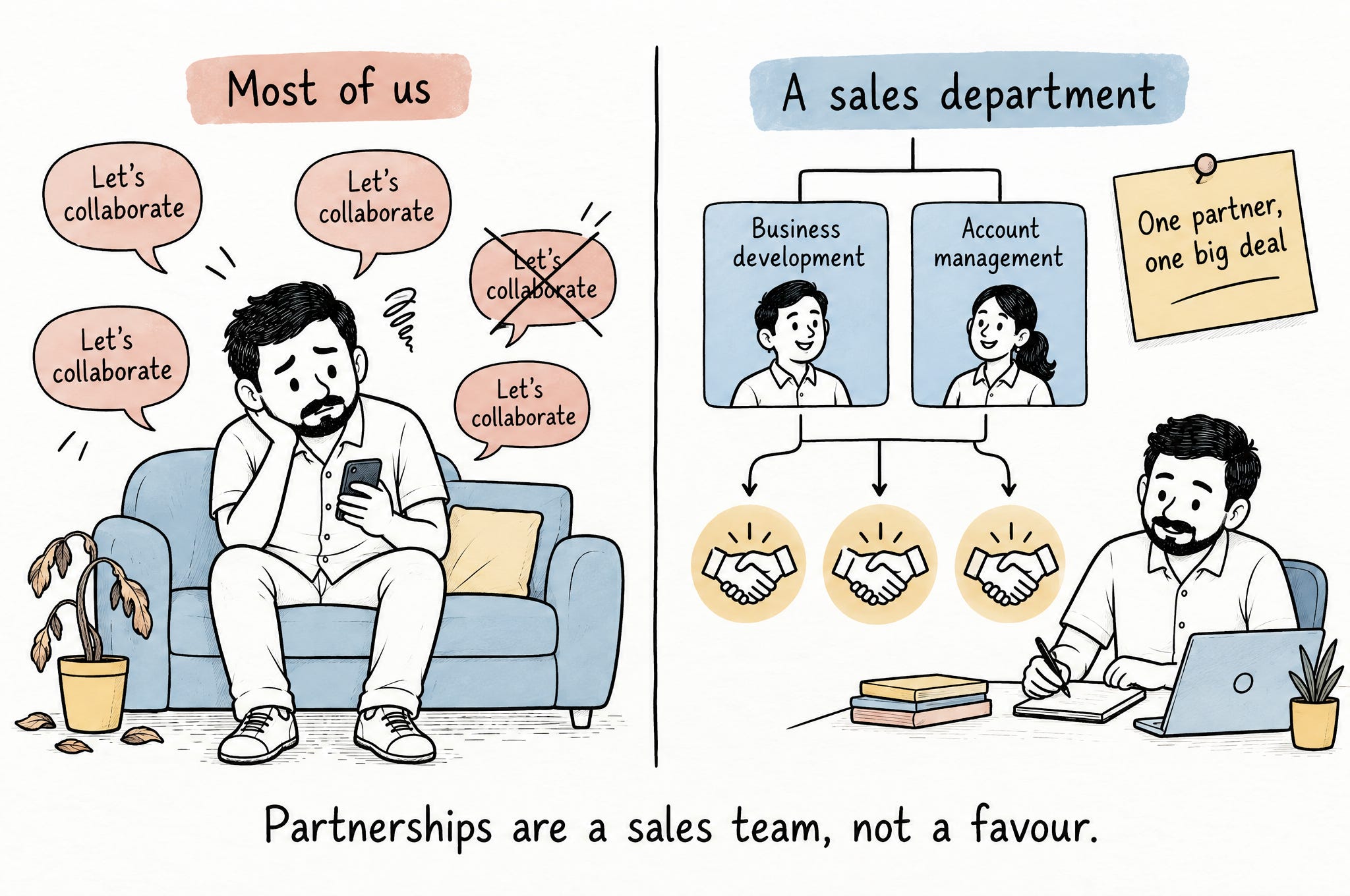
The reframe that made it work: he stopped thinking of partnerships as relationships and started treating them as a business to business sales team. Each partnership is worth somewhere between $50,000 and $200,000 to him. If a deal is worth that much, you do not chase it in your spare time between client calls. You hire for it.
So he has business development people who go out and get the partners, and account managers who keep those partners happy. One person, Pedro, runs the whole arm. Chandler is not the one sending follow up messages.
That is the part that breaks people’s brains, and it broke mine too when I first heard it. He will be on stage at 50 to 70 events this year. He will personally speak at maybe 10 or 15 of them.
We do the opposite in India. We treat every collaboration as a favour between two founders, we do it ourselves, and it dies the moment we get busy. He built a department. That is the whole difference.
The three things a good partner’s room has
Here is his filter for choosing rooms, and it is worth writing on a wall.
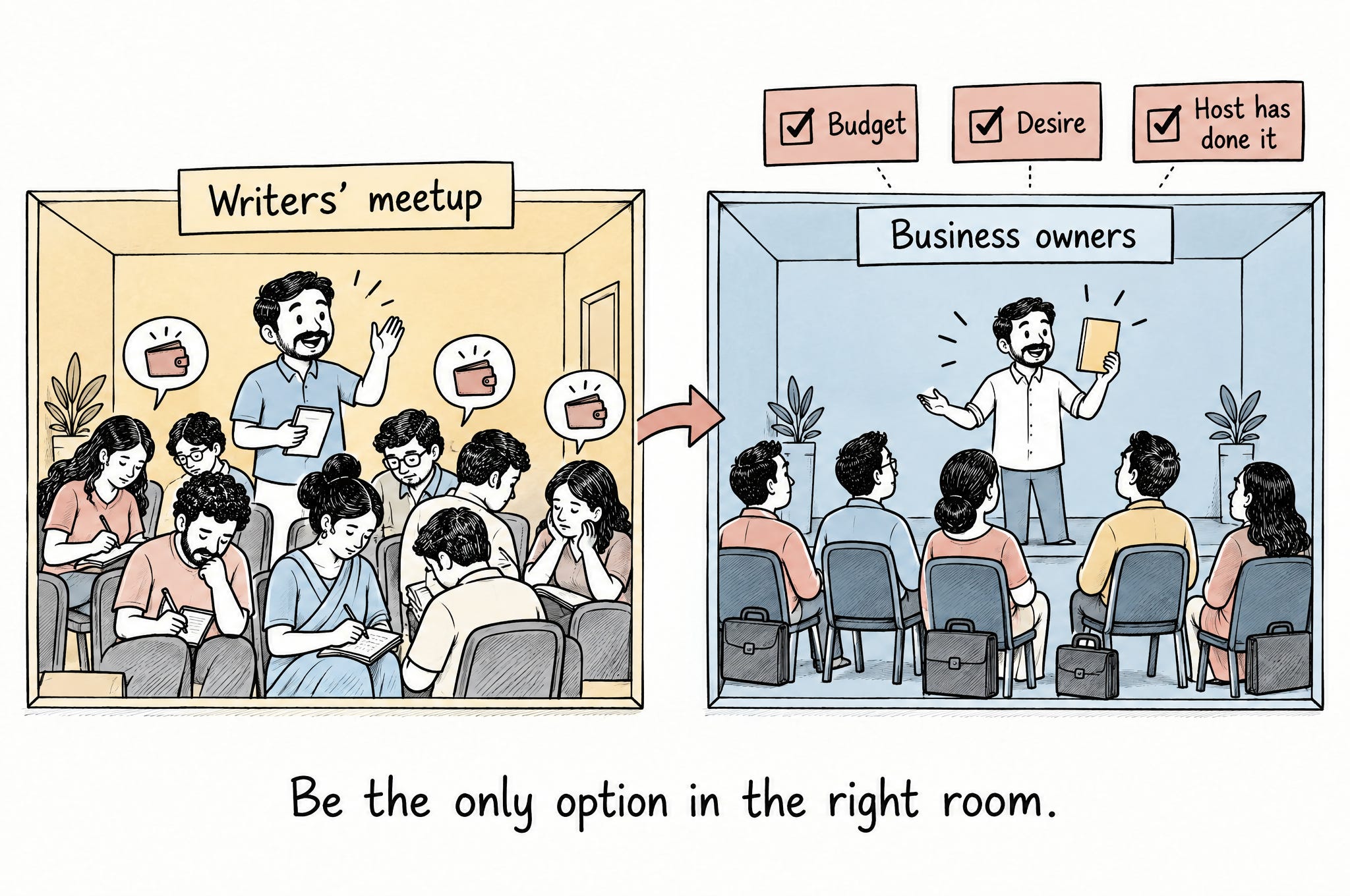
He does not go to writers’ conferences or author meetups. That sounds obvious only after you hear it. Those rooms are full of people who want to write books and have no money to spend on their business. He would rather be the only option in a room of business owners than the most impressive option in a room of authors.
A good partner’s audience has three things:
They have budget. If they paid to be in that room, they have budget.
They have desire, or desire you can stoke in twenty minutes. Publishing has to be at least adjacent to what they already want.
And, best of all, the person who runs the room has done the thing themselves. When the host has published a book and says from stage that it was one of the best decisions of their career, you are borrowing their authority. He says one host who is a published author has sent him more customers than almost anyone.
That third point is the one people skip. You are not looking for an audience. You are looking for a host who will vouch.
He also tells a story about his first paid stage. He drove fifteen minutes down the road to speak to 27 orthodontists, walked out with $18,000, and went to the beach. Twenty seven people. Not a stadium.
The no pitch pitch
Here is what I found most useful, because this is the mechanic you can copy tomorrow.
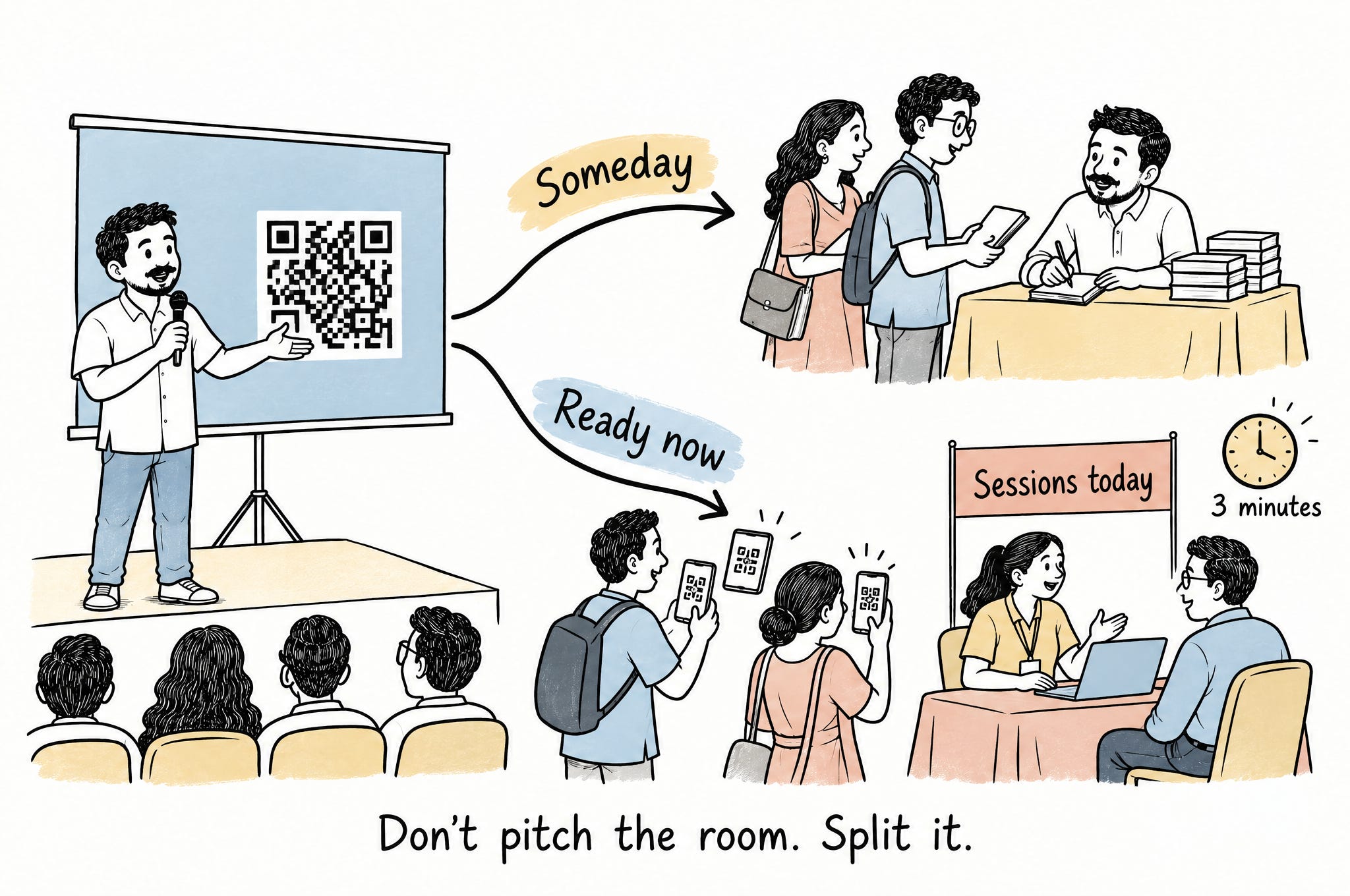
Everyone assumes he shows up and hard sells the room. He says he has sold from stage at someone else’s event about five times in his life. Instead, the talk is pure value, and the last three minutes split the room into two groups.
Group one: the people for whom a book is a someday, maybe next year idea. They get a free copy. He signs it after the talk. The book sits on their shelf until they are ready.
Group two: the people for whom it is a live priority right now. QR code, book a call, and his team runs those sessions on the spot at the venue, with an event only offer.
That is it. Three minutes. The organiser never feels their room was hijacked, the audience never feels pitched, and a typical event produces $50,000 to $100,000, with at least half of it closed in the room.
Notice what the book does here. It is the graceful exit for everyone who is not ready. Without the book, the someday group walks away with nothing and forgets you in a week. With the book, they walk away holding you.
He also has a checklist his team insists on before agreeing to an event: speak on day one, ideally just before a break, have a booth, and get at least twenty minutes. When those conditions are met, the numbers work. When they are not, they often do not.
And here is his honest bit. Some events rip, some bomb. He wasted months beating himself up over the ones that bombed before realising it is a portfolio, like a set of ad campaigns. Judge it across ten rooms, not one. If the whole portfolio returns five to one, keep going.
One more thing he noticed: the customers who come from rooms stay the longest. His highest lifetime value clients come from events, not from ads. The way a relationship starts shapes the whole relationship. Someone who watched you teach for thirty minutes arrives without the layer of suspicion that an ad creates.
This is the same idea I wrote about last time as the ESL, the experience sales letter. Give people the real experience first. The sale becomes almost boring after that.
One talk, one book, many speakers
Now the part that makes it a business rather than a personal hustle.
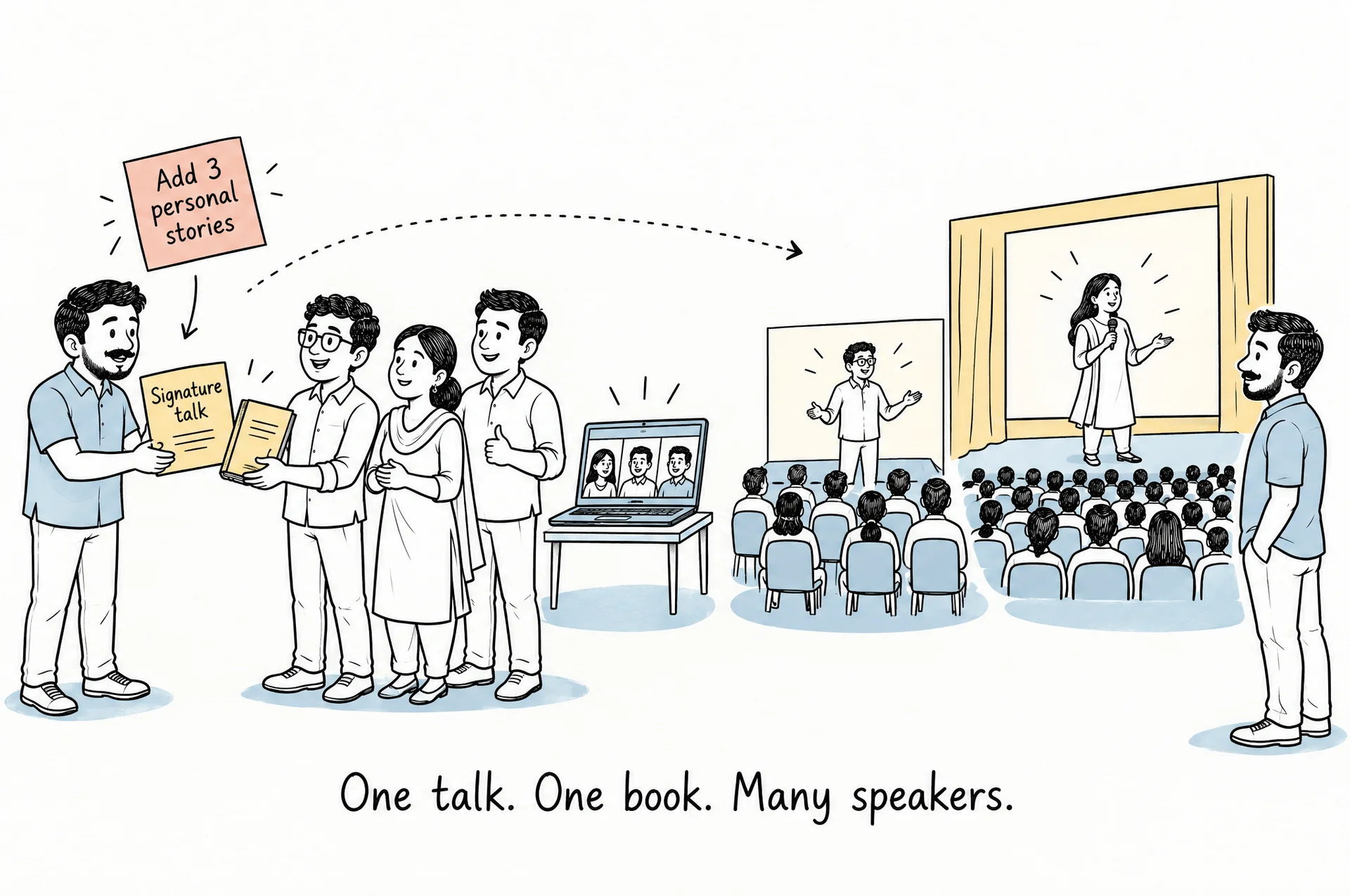
He has one company signature talk. He hands a new speaker two things: that talk and the book. The instruction is to add three personal stories to the talk and go. The book carries the methodology, so the speaker does not have to be the genius. They just have to deliver it.
His best speakers are his best salespeople and coaches, people who are already on the team and already know how to sell one to one. Speaking is just selling one to many. There is a ladder: a small webinar with five to fifteen people, then a small local event, then a bigger webinar, then a big stage. One of his team members eventually opened for a room of 1,500.
And here is the answer to the question every Indian coach asks me: does the audience mind that the founder did not show up? He says no, not typically.
This is why the book matters more than the founder’s calendar. Your framework, written down and printed, is what lets someone else stand up and represent you without garbling it. Ashish is writing his own book on AI for the same reason. Once the method exists on paper, it stops living only in your head.
Digital real estate, and what replaces it
His second channel was SEO, running at around $5 million a year at its peak.
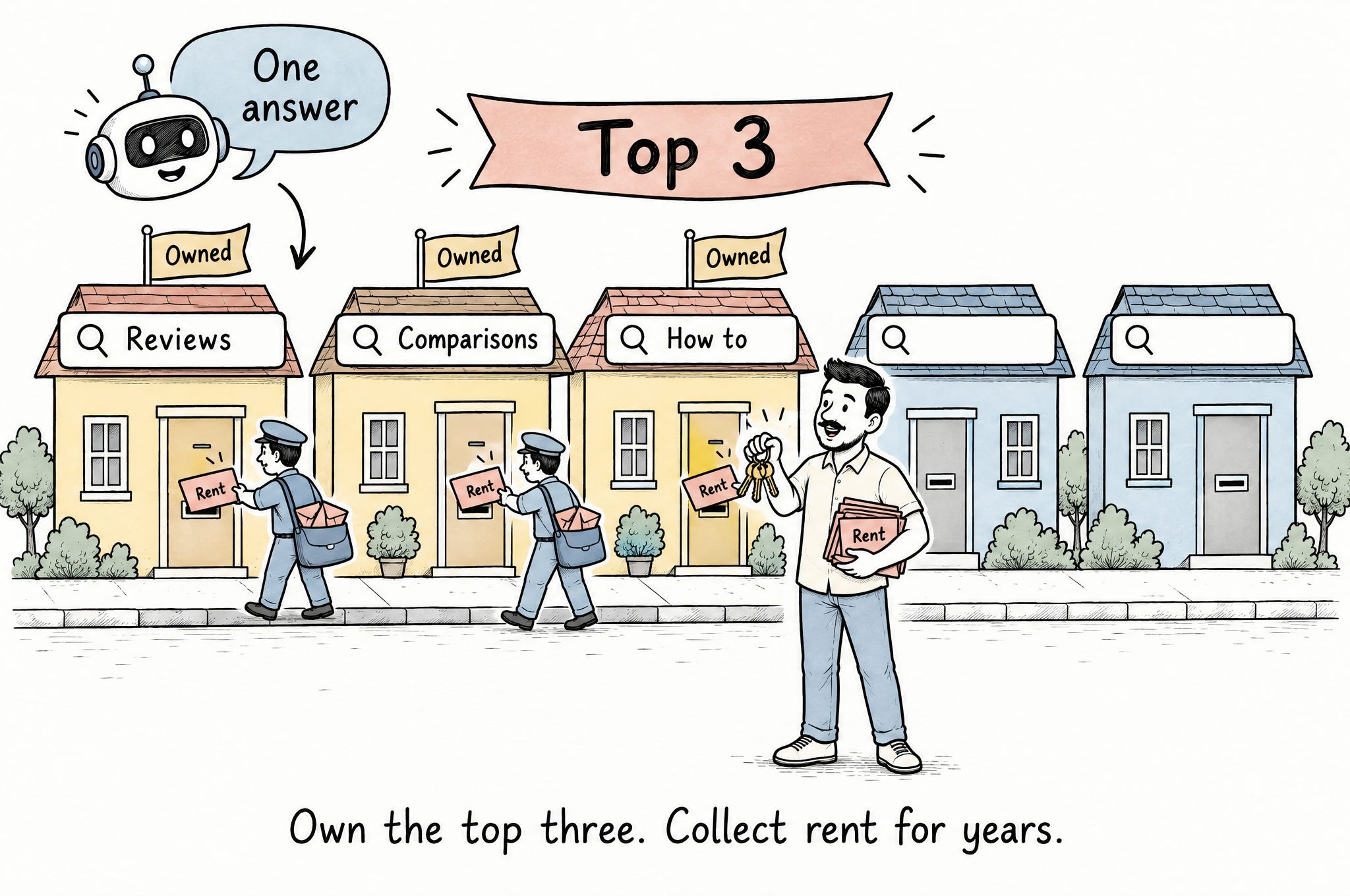
His framing: the top three results on Google are digital real estate. Everyone was busy buying flats. He bought search results. He built content assets and he bought existing ones, including the selfpublishing.com domain itself. Traffic costs nothing, so the customer acquisition cost is close to zero, and the asset pays rent every month for as long as it ranks.
His method, after paying agencies to learn it, came down to two things. Create genuinely good content, and get backlinks. Everything else is detail.
I have lived a small version of this. The post I wrote in 2014 about publishing a book without paying for an expensive programme has ranked for twelve years, right below that programme’s own listing. I wrote it once. It has been working ever since. I just never treated it as a portfolio the way he did.
Now, AI is eating this. He is clear that traditional SEO is weakening, and he thinks the winners will win bigger because AI gives one answer instead of ten links. His approach for what comes next is the useful part:
Start as close to the purchase decision as possible, then work backwards. What do people search in the last five minutes before they buy? They search for services, comparisons and reviews. So create the best content in the world on exactly those queries.
His highest leverage version of this is honest reviews of competitors. Those pages are easy to rank and they catch people at the moment of choosing. The rule he insists on is that the review has to be genuinely fair, otherwise you lose the reader in the first paragraph.
He also pays attention to where the AI tools actually get their answers, which is increasingly forums, Reddit and review sites, because those read as closer to the truth than polished marketing pages.
And he thinks in verticals. Google, YouTube, podcast apps, Amazon, review sites. Wherever someone might search for what you do, he wants to be in the top three. Create once, repurpose everywhere.
Views are not the scoreboard
He spends around $500,000 a year on his media team, roughly $40,000 a month. It is currently at about break even in directly attributable revenue.
The insight he shares is that his revenue has been growing much faster than his views, which annoyed him at first until he realised that is the point. One post did about $75,000 in revenue with 500 views, because it spoke to exactly one kind of person with exactly one problem.
Both of them, host and guest, land on the same principle: speak past your avatar. Make content for the person one level above the customer you want, and the customer you want will aspire into it. If you make content for beginners, you get beginners.
And he is blunt about attribution. He thinks it is one of the most overrated words in marketing, because it takes hundreds of touches to create a customer and your dashboard will only ever credit the last one.
I felt this with my own book. I have posted 2,000 copies to my list. Not one of those copies has a tracking pixel. I will never be able to draw a clean line from a book on someone’s desk to a payment. It still works.
His advice on your first book
At the end, the host asks the obvious question: should I write one?
Chandler calls a book “a silent salesman”. It works while you sleep, it never takes leave, and it never has an off day.
Then he gives advice that lines up almost exactly with what I told you in the last post, which is why I am sharing this at all.
Do not write your big mass market book first. Write the narrowest possible 20,000 to 30,000 word book that solves one specific problem for one specific customer. No big launch. No expectations beyond bringing in customers. Integrate it into your business as an asset and move on.
Books are iterative. His first edition did a few million dollars. He then rewrote it, and the second edition has done eight figures.
His line about authors is one I will be stealing: there are no one book authors. People have either written zero books or they have written seven. Once you know how, you keep going.
Deep Marketing was on its tenth or eleventh version before it went to print. Deep Offers has been rewritten more times than I want to admit in public. That is not a sign something is wrong. That is the process.
He also points out that the book is dual purpose inside the company. One of his customers uses his own book as a sales asset for prospects, as onboarding for new clients, and as a recruiting tool for new hires. One asset, three jobs.
How I would run this in India
Now the translation, because you cannot lift a US model into an Indian market without adjusting the arithmetic.
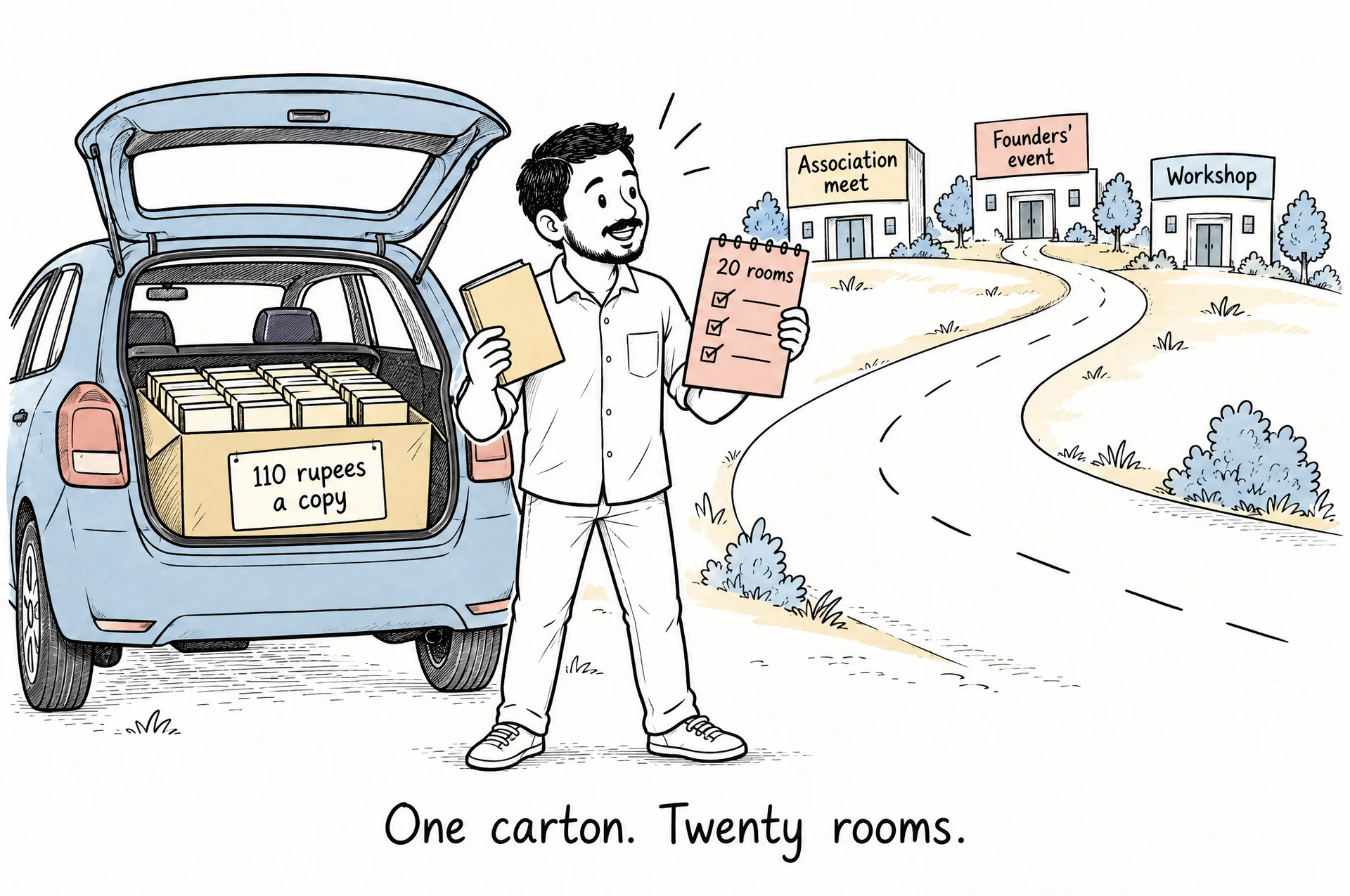
Printing is cheaper here, so the giveaway costs almost nothing. A bulk offset run puts a copy in your hand for around ₹110. Books carry no GST. Walk into a room of 200 business owners with 100 copies and your entire someday pile costs you about ₹11,000. In the US, the same move costs several times that once you add shipping.
Your rooms already exist. Look for places where business owners have already paid to be present: BNI chapters, TiE events, industry association meets, CII and FICCI chapter programmes, franchise and business expos, dealer and distributor conferences, professional body chapters for CAs and doctors, and other coaches’ paid workshops and masterminds. Apply his filter to each. Budget, desire, and a host who has published something themselves.
Some Indian events will ask you to pay for the slot. Do not be offended by it. Treat a paid slot as a media buy and judge it the way you judge ads, across ten events rather than one. If the portfolio returns five to one, keep buying.
Start with partner webinars before you chase stages. They cost nothing, they are faster to arrange, and they let you test whether your talk actually splits the room. He started there too.
Change the QR code destination. In the US he sends people to a booking calendar. Here I would send them to WhatsApp. A prospect who has just watched you teach will message on WhatsApp far more readily than they will fill a form, and your team can move that chat to a call within the hour.
Run the sessions in the room. This is the part not to soften. Momentum dies in the car park. If you are speaking at an event, your team should be there taking conversations immediately after, even if that team is you and one person.
Build your own digital real estate in parallel. Write the review and comparison content for your category. Honest, third party, genuinely useful. Almost nobody in India is doing this well, and those pages will still be working for you when this year’s ads are forgotten.
What to do this month
If your book is printed, or nearly printed, here is the sequence.
Get 500 to 1,000 copies printed in bulk so that giving one away never feels expensive. Turn your book’s core framework into one signature talk of at least twenty minutes, the same talk every single time, so it gets sharper instead of newer. Make a list of twenty rooms where your buyers have already paid to be present, and find out which of those hosts has published a book. Set up the two step close at the end of the talk: a signed copy for the someday group, a QR code and a conversation for the ready group. Put the book into every follow up you already do, including sales calls that did not close, new client onboarding and new hires. Then track customers per room instead of views, and judge the channel across ten rooms.
The real lesson
The thing I keep coming back to is that none of this works without the book.
The partnerships work because the book gives the someday group something to hold. The speaker system works because the book carries the method so someone else can deliver it. The content works because the book is the source material. The follow up works because a book does not get deleted.
He spent a decade building that engine. You now have an unfair advantage he did not have, which is that the writing part, the part that used to take a year, can be done in a fraction of the time with AI. I showed you exactly how in the last post.
So the excuse is gone. Publishing costs a few thousand rupees. Printing costs ₹110 a copy. The only thing left is deciding which twenty rooms you are walking into with a carton in the boot of your car.