

Most businesses don’t fail because their product is bad.
They fail because the customer does not understand the product.
They fail because the customer does not trust the seller.
They fail because there is too much noise in the market and not enough depth in the communication.
If you are selling something simple, cheap, and familiar, you don’t need a lot of marketing depth.
If someone is buying a packet of biscuits, a toothbrush, a pen, a basic T-shirt, or a phone charger, they don’t need a 30-minute video, a 2,000-word article, a webinar, or a personal conversation before they buy.
They already understand what the product is.
They compare the price, the design, the features, the reviews, and they buy.
But if you are selling something expensive, complex, premium, transformational, or trust-based, the game changes completely.
A business owner will not hire a freelancer or agency owner just because they saw one Instagram post.
A student will not join a mentor’s premium program just because they watched one reel.
A patient will not choose a cosmetic surgeon just because they saw one ad.
A high-net-worth individual will not trust a wealth advisor just because they saw a few posts on LinkedIn.
A couple will not hire an interior designer for their dream home just because the designer has a beautiful logo.
When the decision is expensive, emotional, and important, people need education before they buy.
That is where Deep Marketing comes in.
Deep Marketing is not just about getting attention.
It is about building trust at scale.
It is about helping your audience understand the problem, understand the solution, understand your process, understand your philosophy, and finally understand why you are the right person to help them.
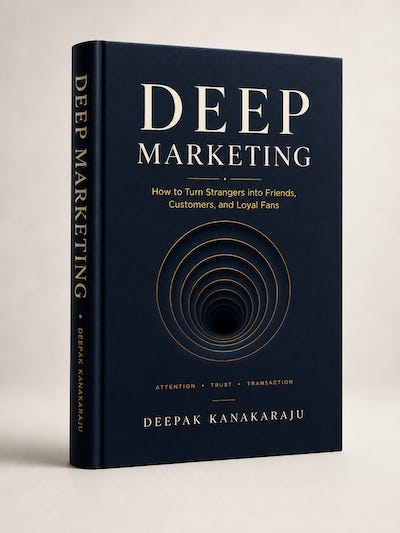
This is why I wrote my book, Deep Marketing.
In the book, I explain how experts and personal-brand-driven businesses can use content, attention, trust, and transactions to attract premium clients.
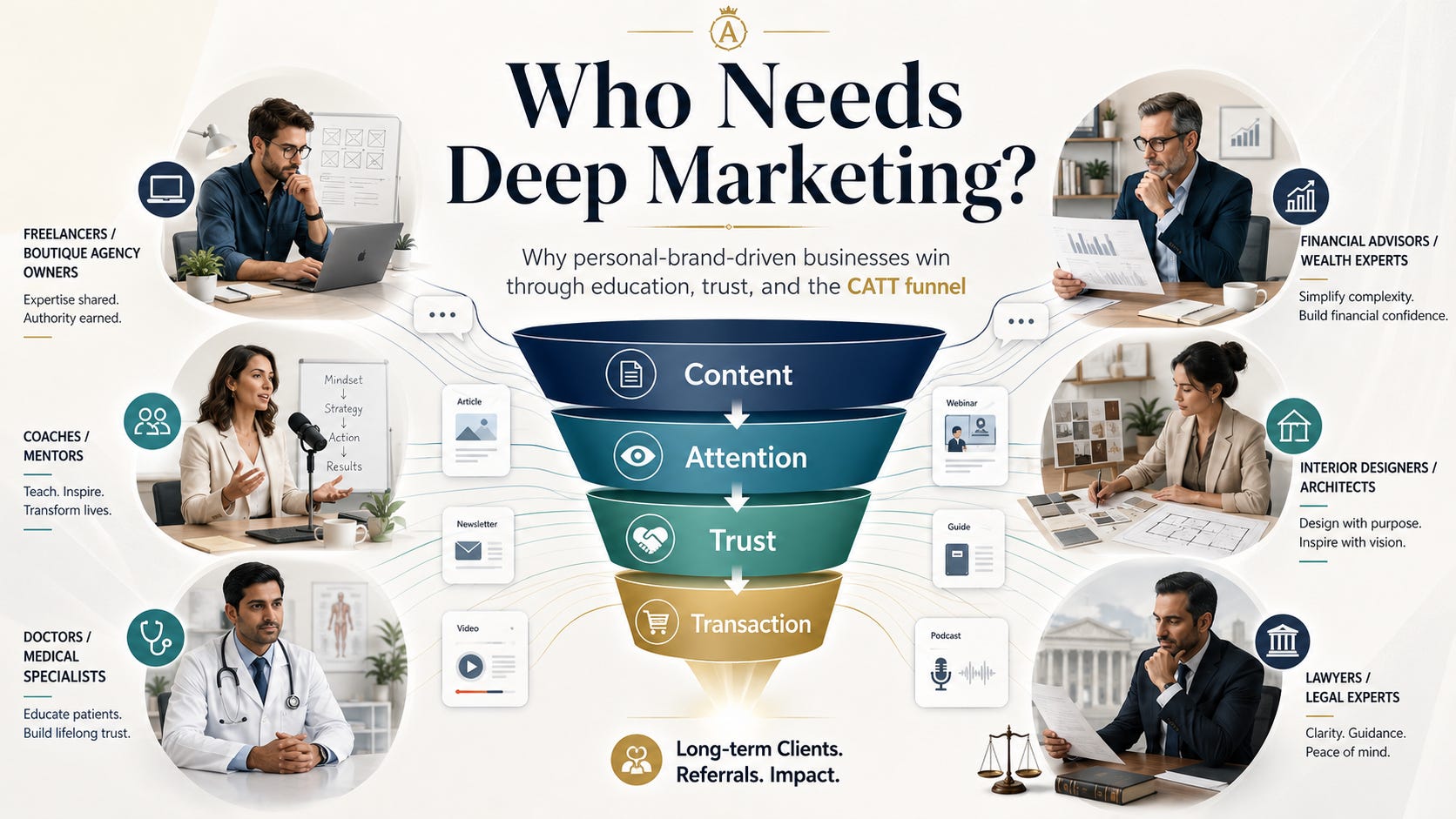
I call this the CATT funnel:
Content → Attention → Trust → Transaction
Most people get this sequence wrong.
They try to go directly from attention to transaction.
They run ads and ask people to buy.
They post reels and ask people to book a call.
They create viral content and expect serious customers to show up.
But premium customers don’t buy that way.
A premium buyer needs more than attention.
A premium buyer needs trust.
And trust is built through education.
Why customer education is the foundation of premium selling
The more expensive your product or service is, the more education your customer needs.
This is not because customers are unintelligent.
It is because serious buyers are careful.
When someone is about to spend a few lakhs, or sometimes even a few crores, they don’t make the decision casually.
They want to understand what they are buying.
They want to know the risks.
They want to compare alternatives.
They want to know whether they can trust the person selling it.
This is true for almost every premium category.
A business owner hiring a freelancer, consultant, or agency wants to know whether the person really understands their business, whether they have solved similar problems before, whether they have a process, and whether they can create measurable outcomes.
A person joining a premium coaching program wants to know whether the mentor has real experience, whether the framework works, whether the community is serious, and whether the transformation is possible for them.
A patient considering a hair transplant wants to know whether the procedure is safe, whether the results will look natural, how long recovery will take, and how to choose the right doctor.
A person choosing a wealth manager wants to know how their money will be managed, how risk will be handled, whether the advisor has integrity, and whether the advice is suitable for their life stage.
A person hiring an architect or interior designer wants to understand the style, process, timelines, materials, budgets, taste level, and how the designer thinks about space.
In all these cases, the customer does not just buy the service.
They buy confidence.
They buy clarity.
They buy trust.
They buy the expert behind the service.
And this is why shallow marketing is not enough.
A social media post can create awareness.
An ad can generate a lead.
A reel can make someone notice you.
But deep trust is built through deeper communication.
That is why long-form content still matters.
Emails matter.
Books matter.
Webinars matter.
Videos matter.
Case studies matter.
Stories matter.
Frameworks matter.
The more premium your offer, the more your customer needs to experience your thinking before they buy.
Why personal-brand-driven businesses cannot survive without personal branding
There are some businesses where the company brand is enough.
If you are buying a bottle of water, you don’t need to know the founder’s philosophy.
If you are buying a pack of detergent, you don’t need to know the personal story of the person who created it.
If you are ordering a low-cost product online, you mostly care about price, reviews, and delivery.
But when the business is built around expertise, the expert is the brand.
If you are a freelancer or agency owner, your client is not just buying execution. They are buying your thinking, your taste, your process, and your ability to deliver outcomes.
If you are a coach or mentor, your student is not just buying information. They are buying your guidance, your belief system, your experience, and your method.
If you are a doctor, your patient is not just choosing a clinic. They are choosing you.
If you are a lawyer, your client is not just choosing a law firm. They are choosing your judgment.
If you are a financial advisor, your client is not just buying a financial product. They are trusting your thinking.
If you are an interior designer or architect, your client is not just buying furniture and layouts. They are buying your taste, your imagination, and your ability to create a space that reflects their identity.
In all these cases, the personal brand is not optional.
It is not a vanity project.
It is not about becoming famous.
It is not about getting followers for the sake of followers.
A personal brand is a trust asset.
It helps people understand who you are, what you believe, what you know, how you think, what you stand for, and whether they can trust you.
A strong personal brand reduces the cost of customer acquisition.
It makes referrals easier.
It increases pricing power.
It shortens the sales cycle.
It attracts better customers.
It helps you become known for a specific outcome in a specific market.
And most importantly, it makes your marketing more human.
People don’t connect deeply with logos.
People connect with people.
Deep Marketing is the best method for personal branding
Most people think personal branding means posting content every day.
But that is only a small part of it.
Personal branding is not just about visibility.
It is about trust.
And trust cannot be built with random content.
Trust is built when your audience repeatedly experiences your expertise, your worldview, your values, your stories, and your ability to solve their problems.
This is where Deep Marketing becomes powerful.
Deep Marketing gives structure to personal branding.
It helps you move beyond “posting content” and start building a real trust engine.
The CATT funnel explains this clearly:
Content creates Attention.
But attention alone is not enough.
Attention should lead to Trust.
And trust eventually leads to Transaction.
This is the part most people miss.
They create content, but they don’t know where it fits.
They get attention, but they don’t know how to build trust.
They generate leads, but they don’t nurture them.
They get followers, but they don’t convert them into customers.
They have an audience, but no funnel.
Deep Marketing connects all these pieces.
Your blog posts, YouTube videos, books, emails, webinars, lead magnets, case studies, landing pages, and sales calls should not exist separately.
They should work together as one system.
The goal is not just to create content.
The goal is to create conviction.
By the time a prospect speaks to you, they should already feel like they know you.
They should already understand your philosophy.
They should already trust your expertise.
They should already know why your solution is different.
That is when selling becomes easier.
Who needs Deep Marketing the most?
Deep Marketing is not for every business.
If you are selling low-cost, simple, impulse-buy products, you may not need this level of depth.
But if you are selling something premium, complex, customized, or trust-based, Deep Marketing becomes essential.
Here are some of the people who need it the most.
1. Freelancers and boutique agency owners
Freelancers and agency owners are one of the best examples of personal-brand-driven businesses.
Many freelancers struggle because they are seen as vendors.
They compete on price.
They send proposals.
They wait for referrals.
They depend on platforms, networking, or word of mouth.
And because they do not have a strong personal brand, the client compares them with ten other people who seem to offer the same service.
This is why many freelancers remain stuck even when they are talented.
The problem is not lack of skill.
The problem is lack of perceived authority.
When a freelancer or agency owner builds a personal brand, they stop being seen as a service provider and start being seen as an expert.
A copywriter is no longer just someone who writes pages.
They become a conversion strategist.
A web designer is no longer just someone who builds websites.
They become a digital experience expert.
A video producer is no longer just someone with a camera.
They become a storytelling partner.
A marketing consultant is no longer just someone who runs ads.
They become a growth advisor.
This shift is powerful.
Because experts are not compared like vendors.
Experts are trusted.
Experts are sought after.
Experts can charge more.
Experts can choose better clients.
Deep Marketing helps freelancers and agency owners educate their market, show their thinking, demonstrate their process, and attract clients who already believe in their expertise before the first call.
This is why freelancers and boutique agency owners should be one of the first groups to understand Deep Marketing.
2. Coaches and mentors
Coaching and mentoring are pure personal-brand businesses.
People don’t just buy a course.
They buy the mentor.
They buy the framework.
They buy the belief system.
They buy the possibility of transformation.
This is true whether someone is a business coach, career coach, fitness coach, executive coach, spiritual mentor, communication coach, or relationship coach.
The coaching market is also very noisy.
Many people are trying to sell courses, communities, workshops, and coaching programs.
In such a crowded market, shallow marketing does not create enough trust.
A coach cannot survive only by posting motivational quotes.
A mentor cannot build a premium business only by making reels.
A coach needs to show depth.
They need to explain their philosophy.
They need to share their frameworks.
They need to show case studies.
They need to reveal their process.
They need to build a community around their ideas.
Deep Marketing helps coaches and mentors convert their knowledge into authority.
It helps them attract serious students instead of casual followers.
It helps them create a trust-based funnel where people are educated before they buy.
This is why coaches and mentors need Deep Marketing more than ever.
3. Doctors and medical specialists
Medical decisions are deeply personal.
Patients want to know whether they are in safe hands.
They want to understand the procedure, risks, recovery, success stories, and the doctor’s credibility.
This is especially true for cosmetic surgery, dermatology, fertility, hair transplant, dental implants, spine surgery, eye surgery, and other specialized procedures.
A doctor with a strong personal brand can educate patients before they walk into the clinic.
They can answer common doubts.
They can remove fear.
They can build confidence.
They can explain why one treatment is better than another.
And when a patient has consumed enough educational content from a doctor, the first consultation becomes much easier.
The patient does not walk in cold.
They walk in with trust.
This is the power of Deep Marketing for doctors and medical specialists.
4. Financial advisors and wealth experts
Money is emotional.
People work for years, sometimes decades, to build wealth.
They are naturally careful about whom they trust with it.
A financial advisor, wealth manager, tax planner, insurance consultant, retirement planner, or investment expert needs to educate before selling.
A prospect wants to know how you think about risk.
They want to know your investment philosophy.
They want to know whether you are conservative, aggressive, long-term, short-term, product-driven, or client-driven.
They want to know whether you are trying to sell them something or actually protect and grow their wealth.
This cannot be communicated through a brochure alone.
It has to be communicated through content.
Articles, videos, newsletters, explainers, case studies, and personal stories help financial experts build deep trust.
When someone trusts your thinking, they are more likely to trust your advice.
5. Interior designers and architects
Design is personal.
People want to know your taste before they trust you with their home, office, villa, or commercial space.
Interior designers and architects have a huge advantage because their work is visual.
But visuals alone are not enough.
A beautiful portfolio can get attention.
But trust comes from understanding the designer’s thinking.
Why did you choose that layout?
Why did you use that material?
How do you manage budgets?
How do you balance beauty with functionality?
How do you handle delays?
How do you understand a client’s lifestyle?
How do you make a home feel premium without making it look overdone?
These are the kinds of questions premium clients have.
Deep Marketing helps designers and architects communicate their taste, process, philosophy, and expertise.
It helps them become known not just for beautiful work, but for a specific point of view.
And in premium design, point of view matters.
6. Lawyers and legal experts
Legal services are built on trust.
A client choosing a matrimonial lawyer, immigration lawyer, IP lawyer, tax lawyer, corporate lawyer, or real estate lawyer is not just looking for legal knowledge.
They are looking for judgment.
They are looking for clarity.
They are looking for confidentiality.
They are looking for confidence.
A lawyer’s personal brand can help people understand their area of expertise, their way of thinking, and their ability to simplify complex legal situations.
Deep Marketing helps lawyers communicate expertise without sounding like they are aggressively selling.
It allows them to educate the market, answer common questions, build credibility, and become known for a specific legal niche.
In a sensitive field like law, trust matters more than hype.
And Deep Marketing is built for trust.
The future belongs to experts who educate
The market is getting noisier every year.
More people are posting content.
More people are running ads.
More people are using AI to create more noise.
In such a world, the winners will not be the ones who shout the loudest.
The winners will be the ones who build the most trust.
And trust comes from depth.
The expert who educates will win over the expert who only advertises.
The freelancer who shows their thinking will win over the freelancer who only sends proposals.
The coach who teaches deeply will win over the coach who only posts motivation.
The doctor who explains will win over the doctor who only promotes.
The advisor who teaches will win over the advisor who only sells.
The designer who shares their process will win over the designer who only shows finished projects.
The consultant who reveals their framework will win over the consultant who only says “book a call.”
Deep Marketing is how experts turn knowledge into trust.
And trust into revenue.
Get a free physical copy of Deep Marketing
I have explained this entire system in detail in my book:
Deep Marketing: The CATT Framework to Attract Premium Clients
This is not just a book about marketing tactics.
It is a book about how to build trust, educate your audience, create a personal brand, and attract premium clients using the CATT funnel.
I am giving away a limited number of physical copies of the book for free.
This is not an ebook.
This is not a downloadable PDF.
This is a real printed book that will be shipped to your home.
If you want a free copy, enter your complete address in the form.
Once the book is launched, I will update you about the shipping timeline.
If you are building a business around your expertise, your reputation, your knowledge, your personal brand, your clinic, your advisory, your coaching, your consulting, your design practice, or your agency, this book will help you understand how to attract premium clients through Deep Marketing.
Because in the future, people will not just buy from companies.
They will buy from experts they trust.
And trust is built through education.
You are the master of Marketing. Each word you use is like an artist uses their brush for their artwork.