

Picture this.
You wake at 2am with a toothache so vicious you can’t think straight.
Do you go looking for the dentist who’ll take the longest? The one who charges the least?
Of course not. You’d gladly pay double, even triple, for the one who can end the pain in ten minutes flat.
That tiny, obvious choice holds one of the most important truths in business. And most experts spend their entire careers ignoring it.
You are not paid for your time. You are paid for the result.
Let me show you how deep this goes.
It was never about the raw material
A bar of gold earns the trader almost nothing above the market rate. One bar is exactly like the next. There’s nothing of them in it.
But take that same gold and shape it into jewellery, and suddenly it sells for many times more. The metal didn’t change. The making did. The design, the craft, the skilled hands. People happily pay that “making charge” on top of the gold, because they’re no longer buying a commodity. They’re buying what someone did with it.
You see the same thing in any supermarket. A whole lettuce costs very little. Wash it, chop it, seal it in a bag, and it costs several times more, for less actual lettuce. You’re not paying for leaves. You’re paying for the ten minutes you didn’t spend at the sink.
In every case, the value has nothing to do with quantity, or effort, or hours. It’s the result. The solved problem. The pain that’s gone. The time you got back.
And here’s the line worth tattooing somewhere you’ll see it daily:
The poor pay for effort. The middle class pay for affordability. The rich pay for the outcome.
This is the mistake that keeps good, talented experts poor. They price their work by the hour, as if they were selling raw cotton by weight. But your client was never buying your hours. They’re buying the won case, the healthier body, the steadier business. And what that is worth to them is usually miles beyond what your time cost you.
The strange part: cheap repels the people you want
You might think a lower price is a kindness. A way to win more people, to be generous, to compete.
But a low price doesn’t just earn you less. It actively repels the very clients you most want.
Here’s why. Before anyone buys, they can’t judge your quality directly. So they read your price as a signal. A surprisingly low price doesn’t whisper “great value.” It whispers “something’s wrong here,” or “this is for people who can’t afford better.”
Your best clients aren’t hunting for the cheapest help. They’re hunting for the best help, and they use price as one of the clues to find it.
Price yourself like a bargain, and you’ll attract bargain-hunters: the ones who haggle hardest, value you least, and vanish the moment someone cheaper turns up. Price yourself like the serious choice, and serious people start to appear.
“But my clients just won’t pay that much”
I want to look hard at that belief, because it’s the single most expensive assumption an expert can carry. And it’s almost always wrong.
Nobody believed people would pay the price of a small motorcycle for a telephone. Until they did, in their millions. Nobody imagined a cup of coffee could cost what a small meal costs. Until that particular cup, in that particular cafe, became part of who someone felt they were.
People will pay a premium, gladly, the moment two things are true. The value is really there. And they can clearly see it.
And these buyers exist in far greater numbers than you think. In every field there’s a quiet layer of people who are tired of cheap and disappointing, who’d happily pay well for something genuinely good, and who can’t find it. Why? Because all the good experts are hiding at the bottom of the market, competing on price and apologising for their fees.
That underserved group is your market. And you don’t need many of them. You don’t need millions. You need the right few. A handful of clients who pay well and value you properly will build you a better living, and a far better life, than a crowd who pay little and demand everything.
The real obstacle isn’t the market. It’s you.
There’s only one thing standing between you and that price. And it isn’t your clients. It’s your own conviction, or the lack of it.
If you secretly doubt you’re worth the number on the invoice, that doubt leaks. It shows up in the apologetic way you say your price, in the discount you offer before anyone asks, in the small flinch before you name the figure. And buyers feel all of it. They take your own uncertainty as proof.
The way out isn’t a trick. It’s conviction: the kind that comes from knowing, deep in your bones, that what you deliver is worth far more than you’re asking. When you’ve watched the transformations with your own eyes, you can say your price plainly, without apology, and let it stand.
Calm conviction is the most persuasive thing in the world. Before you make a single argument, it tells the buyer the price is simply correct.
Want the whole system?
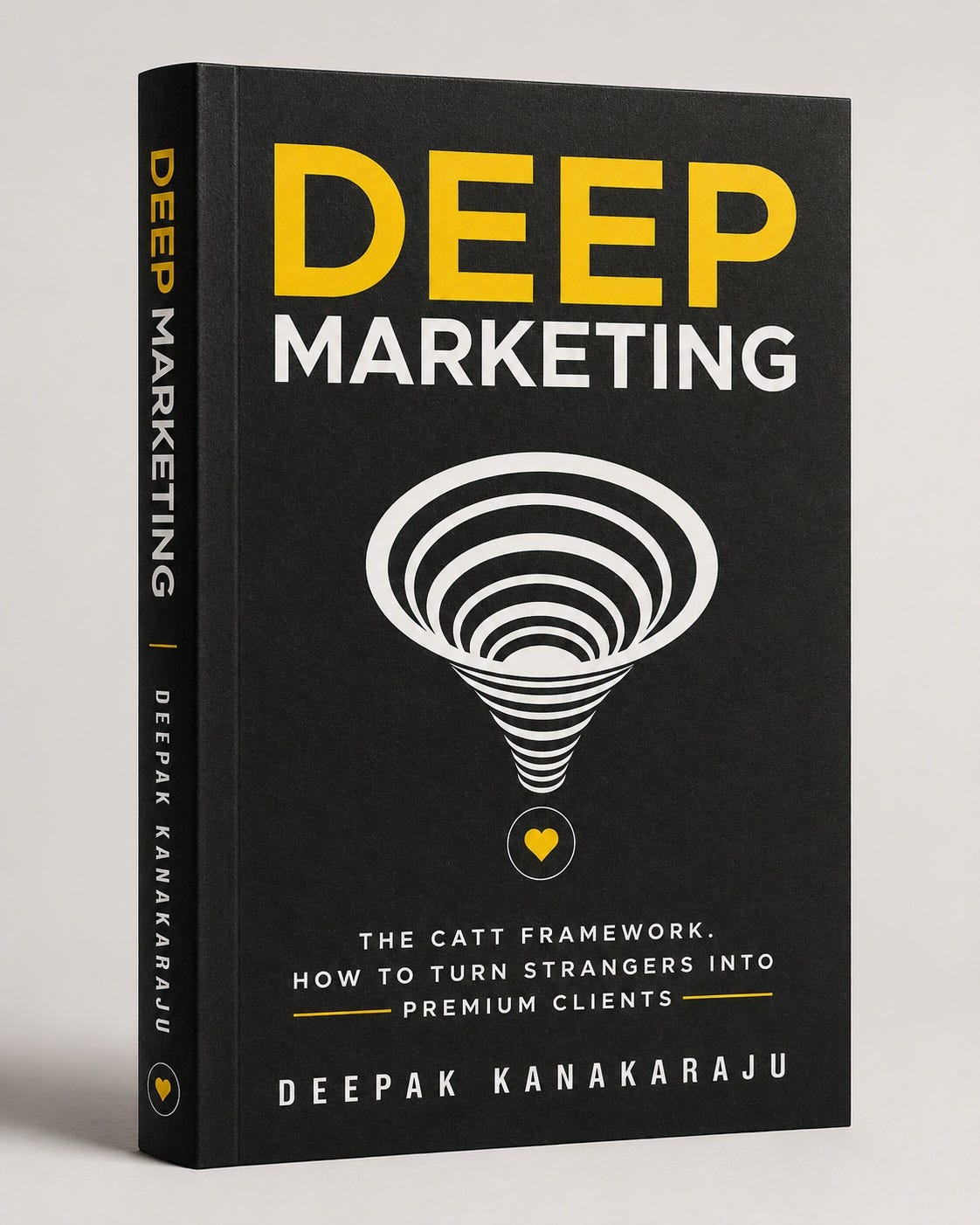
This is just one idea from my book, Deep Marketing, the complete playbook for charging what you’re truly worth, becoming the specialist people seek out, and building the trust that makes a premium price feel obvious.
And right now, I’d like to put a copy in your hands. Free.
No catch. Just the book, and everything it took me years to learn about getting paid for the result instead of the raw material.
If this shifted something for you, subscribe. I write every week about pricing, positioning, and winning the right clients instead of all of them. And remember the dentist at 2am: your clients are out there right now, in pain, looking for the one person who can end it. Don’t make them choose you on price. Make them choose you because you’re the best.